The Ophthalmologist

The start of the PPE had been in the morning, when the vet also looked at my other two horses, who are recovering from tendon injuries.

Sammy got the green light to go slowly back to trot and canter work (File picture with Megan Clements)

Elliot (above) is at least off stall rest now, but it will be at least 6 months until he gets the green light for anything other than walk under saddle.  His injury was both more recent and more serious than Sammy’s. Things don’t look rosy, but we are an optimistic and determined tribe.  🙂

Back to Howdy: My vet reviewed the ra

Back to Howdy: My vet reviewed the radiographs we took of knees, hooves and hocks and there was quite a lot to talk about it.  Some of it was very good news: clean hock and knee joints, no sign of navicular – a good start. The new words I learned were crena and osteochondroma.  The first one is just kinda cool and the second one could matter.

This is a shot of looking straight down on a hoof.  Howdy has a large crena, the notch in the bone in his hoof.  Not indicative of anything, just kinda cool.

Above is where things get a little dicey. That very tiny shadow is a cartilage covered bony protrusion. It could interfere with the deep digital flexor tendon of the distal radius. The little circle thingy that is labeled is literally a remnant of a digit. Horses are really walking on their middle “fingers”. The other digits are fading away, but Howdy is apparently getting in touch with his eohippus side. Taking “old school” to the next level.

After seeing the rads, there was a long wait for the ophthalmologists to see Howdy about his eye.  They told me in the morning it would be around 5 p.m. by the time they could see me, so I left the horses at the vet school, went out to lunch, took my dog for a short, cold walk, did my year end books on my computer and bought me some new barn boots on sale at a store nearby.  Woot.

Duggy got cold in the truck, so she rocked the babushka!

And then she got to come in to the waiting room and hang out with me and pilfer cookies from Becky the ISU Vet School receptionist/scheduler/miracle worker.

End of day finally came and so did the ophthalmologists.  They dilated both eyes and peered in, and bottom line is, yup, horse has an eye infection, a good deal of pain and a miotic (constricted) pupil.  Started topical antibiotic and atropine and banamine.  Even if I don’t buy the horse, I’m not letting an eye infection get out of control on my watch if I can help it.

Howdy behaved well all day, and it was a long one.  Jay helped me settle the horses into the barn and we had a little supper and went to bed.  I sent up a prayer that Howdy’s eye would heal and went to sleep.

On-going Pre-purchase Exam

Waiting for the ophthalmologist

We radiographed everything except possibly his ears.  I did this partially for myself and partially for a baseline in case I decide to market him.  Hooves looked good other than that I was right about a slight club foot on the right front.  Dang, hate being correct that way.  But she said it was mild and probably could be managed with shoeing.   Hocks looked clean – yay.  Stifles looked clean – yay.  Left knee looks good – yay!

But there are three ‘howevers’.

  • However, he has an osteochondroma (little bony protrusion) above his knee that may or may not have caused his left front knee to be positive to flexion.  If it proves to be the problem, it can be removed for about $1,000 and a week or two recovery time.
  • However, we don’t know what caused the slight effusion on the right stifle (though sound as he is behind, and as many bite marks as he has from pasture life, I’m guessing it is a pasture bonk)
  • However we don’t know what is going on with his eye, though it appears to be an infection.  Ophthalmology is coming to look at it this afternoon.

Any of these things separately are probably not a problem.  All taken together, they might not be a problem.  Or any of them singly could be a deal breaker.  This is where a bit of faith and luck, tolerance and being real come in. Horses have a lot of moving parts, both literally and figuratively.  The question becomes, “How tolerant are you to risk?”

For me, I don’t have to answer that question right now.  I’m still waiting on the ophthalmologist.  They’ll call me when they get to him.  I think I’ll go barn boot shopping here in Ames.  Weeeee!

Pre-pre-purchase

Howdy licking the grate, Elliot eating and Sammy working up another whinny

I am hanging out at the Iowa State University vet school with three horses.  Howdy, for his pre-purchase exam; Sammy, for his recheck on a torn check ligament garnered last July at FRVPCHT horse trial; and Elliot for a suspensory avulsion from his sesamoid and a cracked splint bone from a pasture incident in October.  Let’s just say that 2016 had its not-so-fun moments.

But I’m thinking we are going to get a yellow light, if not a green light in putting Sammy and Elliot back to work.  They certainly appear sound.  We’ll see what the ultrasound says.

And now I am looking at Howdy walking around in his stall, licking the auto waterer, munching hay, thinking he might roll and I’m thinking, “I know he’s got something wrong with his left eye.  Is that a club foot on the right front?”  And then he coughs twice and I’m thinking I’ve got a respiratory infection on my hand too.

Time for another cup of tea.  Thank goodness I don’t have Jack Daniels in the trailer, because I’d put some in it.

Just did the flex test. Mild reaction to left knee and mild effusion on the right stifle.  Also some reaction to hoof tester on right front.  Opthalmology will look at his eye this afternoon.  Hopefully this early afternoon.  He is in for radiographs of front hooves, knee and hocks right now.  Ugh.  Blah.  Arg.

Stole Me a Hoss

So I’d been in contact with the owner of Howdy, who lives offsite from where his horses live.  The horses are managed by a person who lives onsite.  The owner said he couldn’t be there to meet us today when we went to pick him up in the early afternoon, and he advised us by text to go to the house and get the manager when we got there.  So we got there, I went and knocked on the door and got a yippy corgi to respond, which I took as a good sign, because no one could sleep through that.  I waited a few minutes and no response.  Then I RAPPED on the door, got the yippy app refreshed, but no human response.

Jay and I had a quick conversation about how to proceed from there and we decided that since we had it in a text that we could take the horse, we’d, well, take the horse!

So, we went to the paddock, and by this time all the horses had come over.  There were about 8 of them, some still racing next year and some yet to race, but Howdy was easy to spot because he did this  (again):

So, feeling like old time horse thieves, we snapped a lead rope on his halter and got him out of the paddock.  Jay trotted him for a soundness check for me, and Howdy trotted like a giraffe, but a sound giraffe anyway.  Howdy’s head was what seemed like 4 feet above Jay’s head, and Jay is about 6’3″.

So, what were we to do but load the horse on the trailer?  He loaded right on with no hesitation and stood there like an old pro.  We closed the slant load dividers and shut the back door, giggling a little at the sheer thrill of being maybe a little bad.

We got him home and offloaded him (ho hum) and let him loose in the indoor just for fun.  The wind was up and the curtains on the arena were snapping occasionally, which was exciting for him, and mirrors are fascinating:

I turned him out in a paddock where he could see the other horses and he was pretty sedate.  Some trotting about, but not craziness, and he likes our hay.  He’s in good weight.  I brought him in and put him in the cross ties to look at his eye, which is a little cloudy on the bottom side, which is worrying to be sure.   It was fine when I saw him in September, but I noticed that he was holding it a little funny in December, and now we seem to have an infection.  Of course he is going to ISU tomorrow, so I am hopeful that they can help us get him back on track.

I will try not to worry about that tonight because worry is an abuse of God’s gift of imagination.  He settled in to his stall, and in keeping with the giraffe theme, he ate the hay out of the TOP of the feeder rather than pulling it out the sides.

Tomorrow’s the pre-purchase exam.  Wish us luck!

Retired Racehorse Project

I’d heard about the Retired Racehorse Project Thoroughbred Makeover (RRPTM) a few times.  I had a vague notion about some event that happens in fall at the Kentucky Horse Park where people competed with their off track thoroughbreds.  I found myself thinking that was very cool.  And I heard an unmistakable distant beckoning. Then my friend was telling me about it and how much fun it is and how many people she met when she competed there last year and did very well in the field hunter division.  I thought that was really cool too, and the beckoning grew a bit louder and significantly closer.

Well, then I got a new farrier in the barn.  Don’t get me wrong, my usual farrier is great and I still use him, but a new client insisted on having this new farrier do her horse while he was in training with me.  Not a big deal to me, so I get the new guy in, and have a cup of tea and chat with him as he works.

After the pleasantries of where do you live, how long have you been doing this and oh, I bet you know so and so, he comments on the barn’s pictures of leggy horses jumping fences and he says, “You like thoroughbreds and you jump.  I know a horse you should go see.  He’s about 17 hands, 5 years old, sound and still at Prairie Meadows in Altoona. Here’s the guy’s number.”

And the beckoning was in the room and the approximate size of an elephant.

So I called the guy and went down to the track to look at the horse.  I get past the guard shack and find the right barn, and stall, and the trainer, and owner and the horse.  At this point, I’m feeling accomplished just having done that.  They show me the horse, “Howdy” and he is indeed about 17h.  He’s also a ridiculous pocket pony, and the owner comments that the exercise riders said that they should have been paying him to ride Howdy because he was so easy to ride.  I thought that might have been laying it on a little thick, but I went with it.  I happened to be in breeches so they assumed I was going to ride him – at the track, down the shed row and in the warm up area on the way to the track.  I’m pretty sure this is against track regulations, but I play mum because, well, I’d like to ride the horse.

So, they put on the mere suggestion of a saddle that is an exercise saddle, lengthen the stirrups as long as they go, and I hop in the tack.  It was ridiculous fun.  I had a grin plastered on my face the whole time.  He walked flat-footed around the shed row, past dogs and radios blaring.  Wow.  Then we went out in the warm up area, which is on the way to the track.  I did some trotting here, and he was tight in his back and high-headed, and relatively short-strided for what you would have thought from his conformation.  I chalked most of that up to general tension.  Then we cantered, and whaddya know, he had an easy two leads.  I know a lot of horses, track or not, who strongly prefer one lead over the other.  I trotted a little more, then headed in.  He jigged his silly self back to the shed row, which was frankly, at times, not fun, but not terrifying either.  I just happen to really object to jigging because it develops all the wrong muscles.  However, Howdy and I had no mutual tools to communicate with so I grinned and sat there like an idiot.

So I got back to the barn and rode him in to his stall (they told me to!  It freaked me out, but apparently it is common practice) got off and offered that he’s a nice horse, and thanked them for meeting with me and showing him to me.  They let slip that he hasn’t been out of his stall in 5 days due to track conditions.  I was glad they did not tell me that before I got on because I would have been all “I’ll come back another day” or “Can I lunge him somewhere?”  Ignorance is bliss.

They told me that his barn name is Howdy because his sire was owned by Toby Keith and they were going to register him as Howdoyalikemenow”, but someone else got the name first.  So they had to name him something else.  And I do not know what that is at this point.  So awesome of me.  Not really, not really. (Prior link is the origin of my use of the phrase “Not really, not really”.  If you object to profanity, do yourself a favor and pass that link right on by.  If you think a smattering of profanity is merely good use of the entire spectrum of the linguistic spectrum, click on, my friend, and enjoy.)

We chatted while they put him on the hot walker and I snap a few pictures.  This one, in particular, strikes me, and I when I looked at it, I pretty much knew I needed to have this horse in my barn.  Why?  Partially because his mostly calm personality shows through, and partially because he looks like Eddie in the picture.  Eddie (Best Etiquette) is my event horse/fox hunter/good citizen, classic thoroughbred, 18 year old gelding.  I look at Howdy and I see what he can be.  He won’t be Eddie, he’ll be different, I know this, and I see that he can be someone pretty great in his own Howdy way.

So we negotiate a price and we agree that I will pick him up in a few months when I will have room in my barn.

Some weeks later, my husband Jay and I went out to look at him at the farm where he was being let down.  (And ok, part of this was to get husband buy-in).  When we got there, Howdy came right to the gate and gave us this face (below).  That was a good start for husband buy-in.  Smart man, Howdy.

Fast forward to tomorrow and we are at that few months later when I will pick him up.  The day after tomorrow Howdy has an appointment for a pre-purchase exam at ISU.  Whee!

I made these cookies to help him decide to get on our trailer tomorrow afternoon.  I may be a little excited.  Hee hee.  We’ll also have cookies for all the horses when he gets home to Field Day.  Nothing makes a better first impression than showing up with food.  I hope the class likes the new kid.

How to learn to ride

IMG_5726_3637

Best Etiquette, Roebke’s Run, September 2014, D and G Photo credit

All I am thinking in this picture is “sternum up.”  I should have been thinking, “put your calf on and let go in your knee” too, but one thing at a time.  One stride after this fence is a very vertical fence, and all season long Eddie and I had been smoking the oxer and subsequently pulling the vertical in the oxer to vertical combination that pretty much is guaranteed to be on any prelim showjumping course.

See the guy in the grey sweatshirt behind me videotaping?  That would be my husband Jay, who is a helluva good videographer – knows how to use the zoom and is rock steady.  And I had seen in video after video, images of Eddie jumping beautifully over the oxer (see Eddie above, he is a ridiculous gift from the Universe for which I am ever grateful) and me not holding my back to the second element, thereby pushing him through the distance and resulting in a pulled rail more often than not.

So through the miracle of video and a star of a husband, I’d learned that I needed to keep my sternum up over the fence and in the stride afterward.  I’m happy to say we jumped double clear and kept our position in second, 0.2 points off the leader, a wonderful young rider who was as thrilled to win as I was to keep the rail up so Eddie wouldn’t give me that look that horses do when they were great and you messed up.

So what happened there?  I learned what was going on, I learned how to fix it, I practiced fixing it for weeks, and then in competition, I had a mantra I repeated like a woman possessed, to make my new habit my default.

Let’s break down the steps of learning new riding habits.

To learn to ride well, first you have to learn where you are in your riding – what you are doing, both good and bad.  When I was a kid, I had an awesome shetland pony named Cricket and we went everywhere in every field, gravel road and woods around our farm in Cascade, Wisconsin.  Damn, I could ride, I was sure of it.  I hardly ever fell off, so I, of course, knew how to ride.  (Great childhood logic, still employed by some wildly average adult riders, but I digress.)  I went to the 4-H show and there were four riders in my class.  I was for sure going to win!  I went in, did my thing, and came out with a white ribbon.  What?!  I was 6, so of course I blamed the judge (another great childhood logic, also still employed by some wildly average adult riders).  My sister, who had attained all the wisdom that 12 years on earth provides said, “Of course. You never got a right lead. Duh.” Clear feedback can hurt, but identifying the problem one way or the other is Step One.

Publicly, I was like, “Oh, well, yeah, of course, no right lead” and then privately I was like, “Aaaaaaaaand, what’s a right lead?”  Now having identified the problem, I moved on to Step Two: Learning How to Fix It.  My brilliant sister and the Sheboygan County 4-H Horse and Pony Handbook (shout out to the UW-Extension system!) taught me about leads.  I learned to identify leads by chasing the horses around in the pasture until I could see which lead they were on (I know, awesome 6 year old logic!) and then my sister let me ride her horse so I could learn to identify them from the tack.  Then she taught me how to cue for one lead or the other on a straight line (Olympics here I come!).  Finally, we went back to my pony and worked on his right lead, which turned out to be no problem once his rider had a solid clue.

I practiced and practiced before my next competition until I could get a right lead in my sleep.  (And in fact, I did think about it before falling asleep at night – how to cue and what it felt like to get a left lead versus a right lead.  I don’t doubt that I did dream about it.)  My mantra on show day had been the one I practiced with, “left leg back, right leg at the girth, sit up”.  And it worked.  I actually don’t remember what ribbon I received, but I remember the feeling of getting a right lead and knowing I had the right lead.  I was grinning like a kid with a smiley face teacher sticker on her spelling test.  I am sure the judge and parent-audience thought I was possessed.  Awesome.

I am still learning to improve my riding, and teaching others to do the same.  Like this:

  1. Learn what is going on
  2. Learn how to fix it
  3. Practice the correct way (develop a mantra)
  4. Use the mantra when under pressure

Step One: Learning What is Going On

Let’s say you are in a riding lesson and your instructor mentions a particular riding flaw and how to correct it – maybe she says it more than a few times.  Or maybe you are watching a video of yourself and you notice a habit you would like to change.  Maybe your horse is telling you that when you ride a particular way, he goes better than when you don’t ride that way.  If you are lucky enough to ride in an arena with mirrors, you can also gain insights by watching yourself and how your riding position affects your horse’s carriage.  These are some of the ways to learn what is going on.

Step Two: Learning How to Fix It

Because William Fox Pitt and I have similar builds, but unlike me he rides with dang near perfect equitation, I use him for an example a lot for myself.  I suggest my riders find a riding hero and look at pictures or video of them to observe and then learn, learn, learn what works.  I made this graphic for one of my riders who is learning to stay centered in turns and to carry her hands properly.  Having a clear mental image of how things should be and the seeing the resultant change in the horse’s carriage because of proper rider position is extremely useful.  You have to know where you are going in order to get there.

wfpweb

Step Three: Practicing the Correct Way (and developing a mantra)

Practicing is largely a matter of brain training.  Let’s say someone is working on holding their hands in the proper position, and keeping them still relative to the horse.  I suggest that they check their position each time they pass a cardinal letter in the dressage arena (A, C, E or B).  (Or maybe the sixth fence post on your outdoor arena or pasture, or every 30 seconds while riding out.  You could set your watch or phone to beep every 30 seconds or whatever.  You get the idea, just be creative.)  What will happen is that (assuming you are in a dressage arena), you can fix your hand position at A and by the time you get to E, your hands have dropped/become uneven.  You fix them at E, and by C, they have fallen again.  In real life, this is what happens when learning a new skill.  How you treat the information that to make a lasting change is to make hundreds of repeated small changes is the deciding factor in whether you will be successful in improving your riding.  You have a choice each time you notice that you have to make a correction to your position.  You can:

A) Judge yourself – hop on the ol’ drama llama and think, “I will never learn this!  I’m a bad rider, I can’t maintain it for 15 seconds!”

or

B) Say “Whoopsie!” laugh, and try again.

If you were teaching your child to walk and they bonked on their diapered butt, what would you say to them?

“You will never learn to walk!  You are a bad walker!  You can’t do it for three steps!”

or

“Whoopsie, honey, good try.  Let’s try again.”

Which hypothetical child do you think learns faster?  Which kid is having more fun?  (Hint, the answer is the same for both.)

Your inner voice should be that of a relaxed friend.  If it isn’t, tell it to dry up and blow away, and then create a new script.  Your inner voice is you.  You can make your inner voice use the tone you like.  There’s a bit about this in the “Black Box and the Gold Box“.

butler-head-waiter-server-luxury-standing-isolated-carrying-tray-man-has-air-class-wealth-male-32561297While  you are learning your new skill, a mantra will naturally develop.  For keeping hands up, I like to think of a butler carrying a tray like this guy.  He has excellent posture, with his shoulder blades down his back and he carries his ribcage and forearms in splendor.  So, “Butler” became my mantra for that.

Step 4: Use the Mantra When Under Pressure.  Now you have identified where your riding needs improvement and gotten into the habit of frequent and kind self-checks. At your next show, where you used to ride around the warm-up just generally trying to do your best while continuously noticing how great everyone else looks, now you have developed the presence of mind and habit of frequent self checks that keep you focused on the fundamental skill you are developing and YOUR riding, not everyone else’s.  So you are replacing self doubt and habitual comparing of  yourself to others with a proactive, familiar mantra.  Your Butler will carry your through!

Very good, Mum.  🙂


Cadence for young horses


With some curious and friendly young connemaras at Elliott Blackmon’s place

U.S. Eventing Team coach David O’Connor was teaching in Ocala early this week on the topic of training 4 year old horses. He shared a story about a cadence he drills into his working students while they are working with the four year olds:
“What are we riding?”

“Four year olds!”

“What are we doing with them?”

“Waiting for them to be 6 year olds!”

Sure ride them. Sure walk, trot and canter. But ever playful. Show them things and let them learn that you are generous and friendly and that work is fun.

A Day with David O’Connor

IMG_5669OK, not really just me and the Dave hangin’ out, but today I was at Longview South in Ocala, FL at the USEA Instructor Certification (ICP) Symposium – kind of a continuing education deal for ICP instructors or other interested  horse junkies.
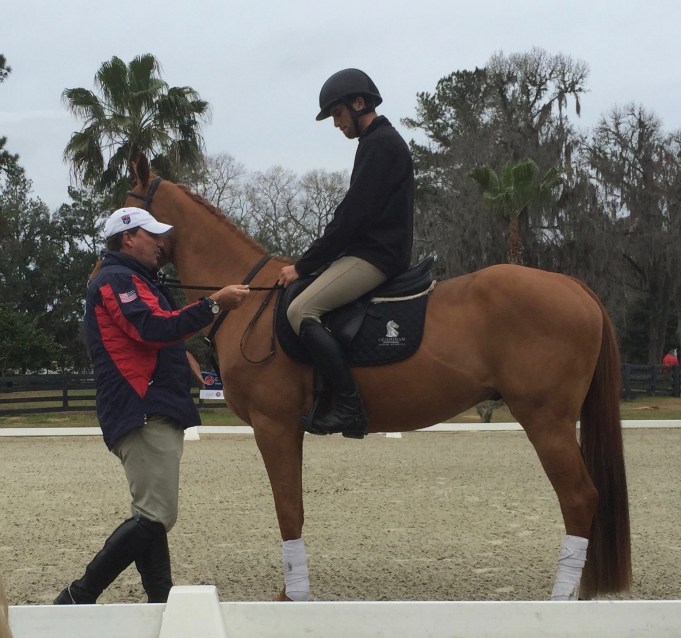
Short random video of leg yield to set the stage:

Robyn Walker making canter look so easy:

The morning started out with a 50 minute discussion on teaching, riding and how horse sports can improve in general.  One of  his recurring themes is that we can borrow from other sports.  He mentioned that he was struck while watching the Super Bowl coverage that the 39 year-old quarter back (and the entire team) warmed up by doing drills.  He was noticing that even those who are experienced and at the highest level of the NFL recognize the value and importance of reviewing sound fundamentals.  (The implication being, of course, the lots of riders skip fundamentals or, once they reach a certain level, they don’t review and renew their skills as often as might be ideal.)   Hmmmm…

Following are some of my notes from the day, most are direct quotes, but some are paraphrased, hopefully faithfully:

  • When learning to ride, there are 5 phases of riding
  1. Technique (learning position and how to communicate with horses.  The vast number of riders are here)
  2. Theory (Camie in: This means read and study in the winter.  You can’t ride?  Read a book, watch videos.)
  3. Instinct (You’ve practiced correctly and studied and visualized it for so long that the correct response is fully ingrained in muscle memory)
  4. Intuition (setting a horse up for success in training and competition)
  5. Imagination (the land where you can create exercises at home and see things in competition that others do not.  Michael Jung lives here pretty much by himself.)
  • Rider responsibilities
    • Straightness
    • Speed
    • Rhythm
    • Balance
    • Impulsion
    • (Camie in: “Dear God, please let this ring at least somewhat familiar in my students’ heads.  Amen.”)
  • For instructors, in a lesson
    • What am I trying to do?
    • How am I going to do it? (Let the exercise teach the lesson)
  • As riders progress, they understand that many problems are skill based, not horse based (A nice way of communicating that “It’s us.  It’s really, really us.  And they sooner we accept our role as the baggage that needs to mostly get out of the horses’ way, the better horses will go for us.” Or “Horses go as we ride them.”)
  • The rider’s aids must be clear and consistent. (One key without the other does not open the lock.)
  • 4 year olds should be allowed to be 4 year olds.  He told a story about his students at his barn, and that he has drilled into their heads: “That is a 4 year old.  What are we doing with him?”  “Waiting for him to be 6!”
  • No bending for 4 year olds (Not a typo)
  • There are three parts to the rider’s body
    • Lower leg
    • The seat, which is knee to lower rib cage
    • The upper body
  • Seat dictates length of stride and tempo
  • Canter transitions from a big trot to a big canter is a good exercise for horses to help them be loose in their backs
  • The most powerful tool is the give (the relaxation of the aids)
  • The quality of the hands is unbelievably important (Please, Master of the Universe, let this not be news to my current students!)
  • On a circle, the inside hind leg should be on the line of travel
  • For canter depart, feel where his haunches are, then canter when ready
  • Leg yield
    • Go from wall toward middle of arena, rather than middle to wall to encourage horse not to run to wall
    • Put weight slightly in direction of movement.  Horses follow weight
  • For turning, think of pushing with the outside aids around the turns.  Push, don’t pull.  “Push to the line, don’t hold to the line”
  • For 4 and 5 year olds, keep their necks straight in front of them and push them around with your legs (laterally supple, etc.)
  • Two kinds of half halts
    • One changes length of stride
    • Other rebalances
  • Young horses should “walk like they’re late”
  • 4 year olds should do transitions between gaits, 5 year olds should do transitions within gaits.
  • Leg yield and shoulder in and haunches in are not ends in themselves.  They are means to an end, like toe touching and strengthening is a way to become a football player (I thought this was brilliant)
  • Can go forward and collect in leg yield
  • An exercise: leg yield in canter to leg yield in trot across the diagonal
  • Cadence = lift
  • Horses need to develop responsiveness to seat aids.  Riders need to remember to use them (before going to hands)
  • And finally, simple way to think about collecting is to “lift the horse in the middle” (with the seat)  The front end and the back end naturally come down.
IMG_5666

This was a typical position for this rider.  David is discussing straight line elbow to bit and a soft elbow.

Great fun today!  More tomorrow.  Subscribe to the blog if you like!

This just in

In a freakishly well-timed and serendipitous follow up to yesterday’s post about horse-training styles, this just in from research at ISU regarding parents’ influence on children.  Dr. Laczniak has done some great work.  Because I am always thinking horses, it occurred to me that if you substitute “riders” for parents, “horses” for children, and “horses acting like monkeys” for “children playing violent video games”, all of the same conclusions could apply. An excerpt from the original article:

Three dimensions of parental styles – warm, restrictive, and anxious-emotional – were examined for the study. In the paper, researchers explained that warm parents tend to refrain from physical discipline and show approval through affection. Restrictive parents set and enforce firm rules for the household. Anxious-emotional parents are often overprotective and show elevated emotions when interacting with their children.

(Dr. Russell) Laczniak says the research team expected children with warm or restrictive parents would spend less time playing violent video games. However, they were surprised to see the impact of anxious-emotional parents. He and his colleagues included this dimension based on past studies, which found that children of anxious-emotional parents tend to have more problems. The biggest takeaway for parents is to set limits and be more calmly detached in the relations with their children.

“If parents want to reduce the amount of violent video games that their kids play, be warm when dealing with them, but somewhat restrictive at the same time, and set rules and those rules will work,” Laczniak said. “For parents, who are more anxious, the rules become less effective and those kids are going to play more.”

– See more at: http://www.news.iastate.edu/news/2015/10/07/parentsvideogames#sthash.X1xJwu8C.dpuf

So it turns out that a game of hot and cold, with an emphasis on the warm is the best way to influence those in our care, whether they be horses or people.

Here is that article with my ridiculously non-academic, horse-related substitutions:

Three dimensions of riding styles – 1) warm, 2) restrictive, and 3) anxious-emotional – were noted by Stockhausen in a very anecdotal manner during her riding and teaching. She noted that warm riders tend to refrain from physical discipline and show approval through affection. Restrictive riders set and enforce firm rules for the ride. Anxious-emotional riders are often overprotective and show elevated emotions when interacting with their horses and sometimes refer to their horses as “fur-children,” to the quiet horror of those passers-by unfortunate enough to overhear that which can not be unheard.

Stockhausen thinks that the completely undisciplined, random observations she has made over time suggest that horses with warm or restrictive riders spend less time acting like monkeys. And she was not surprised to see the impact of anxious-emotional riders. She includes this dimension based on past experience, which noted that horses of anxious-emotional riders tend to have more problems fitting in to polite horse society. The biggest takeaway for riders is to set limits and be more calmly detached in the relations with their horses.

“If riders want to reduce the amount of monkey-like horse behavior, they should be warm when dealing with them, but somewhat restrictive at the same time, and set rules, and those rules will work,” Laczniak originally said about people and Stockhausen completely agrees when applied to horses. “For riders who are more anxious, the rules become less effective and those horses are going to act like monkeys.”


My grateful apologies to Dr. Laczniak for allowing me to ride the coat tails of his excellent work to help me express what I have noticed in my mere anecdotal equestrian observations.  If I have some thing to add to the Universe it is only because I stand on the shoulders of giants.

Thank you Dr. Laczniak.

Hot and Cold

I am on a TED talks kick.  ‘TED’ stands for Technology, Entertainment and Design, and their byline is “Ideas Worth Spreading.”  Love TED.

The latest TED talk that reminded me of horses is a talk by Amy Cuddy about how your body language shapes who you are.  During the talk, she is describing the design of their experiment.  The subjects are to go to a job interview, but before they do, they are to be in a power pose or a non power pose for two minutes before the interview.  The interviewers have been trained to withhold giving any body language back to the interviewees and only speak to them as they must.  She remarked that “People hate this!” and I thought, “Horses do too.”

And now for a break to look at a really pretty horse and William Fox Pitt, a magnificent rider:   I made this graphic for another application so it has a few things that are not quite on point, but maybe not a complete bore either.  But the point I want you to take from this is that WFP is giving the horse genuine positive feedback.

WFPWTNwebNow back to horses and feedback.  Horses are in a funny position.  Even the clumsiest among them can run faster than the fastest among us.  Many of them can jump higher than we are tall.  Yet, we come along, over-confident athletically untalented bipeds that we are and commence to boss them about in a language they don’t initially understand, and doing so in some cases, in a manner that is too quick and too presumptive.  Horses, half of the time, are just trying to figure out what in the heck it is we want from them.  The main string they have to play on, being powerful beings of flight, is the one string that most people who ride them don’t want them to play on, ever.

So people ride horses and try to communicate what they want the horses to do, but for the most part, riders default to communicating what they do not want the horse to do.  “Now Trigger, don’t buck, don’t rear, don’t shy, don’t go to fast, don’t be barn or buddy sour” and on and on.

It becomes like the old game of Hot and Cold where a group of people is trying to get a player to find an object that the group knows, but the player doesn’t.  If the group is required to only direct the person with negative directions, like saying ‘Cold’ when the player is not near the object, but not every using Warm and Hot for correct moves, the player has to keep stumbling in the metaphorical dark and it takes a very long time for the player to find the object.  If however, the group can use, Warm and Hot to indicate when the player is moving in the right direction or nearly being successful, the game goes a lot more quickly, and, incidentally, is more fun for all.

That situation is like a rider training a horse.  If the rider only uses Cold training, punishing the missteps and ignoring the correct ones, it takes a very long time for the horse to understand what is desired, and it isn’t much fun for either party as the horse stumbles about in the metaphorical dark.  But if the rider (who is always training, for better or worse) can use Warm and Hot training, such as “rewarding the try” and giving frequent praise for correct work, the learning curve becomes exponential, and incidentally, is more fun for all.

This video is a case in point.  This is me on a four year old OTTB named Merida, sometimes called Monkey for good reason, going over her first cross rail.  She wobbles on the approach, but gets over the fence just fine.  I praise her immediately.  I don’t wait several strides to praise her.  I don’t wait until she does it perfectly to praise her.  I don’t stop her to praise her.  We keep going forward and I let her know that what she did was good.  In immediately taking the pressure off her by praising her, she starts to think this jumping thing is something she is good at.  Whether she will be or she won’t be a good jumper is dependent somewhat on her physical talent, but whether she will try with her whole heart is dependent on the response she gets from her rider.  What we are really doing when we train horses is influencing their minds and growing their confidence.  The physical follows.

Now what if Merida had run out and avoided jumping the fence?  What does a thinking rider do?  I think they make no comment to the horse, make sure that their own riding is correct, and simply re-present to the fence.  Why?  Because giving no feedback is punishment.  Subtle punishment, but just like the above example in the experiment with the job applicants getting no feedback from the interviewers, giving no feedback is very uncomfortable.  For a green horse who lacks jumping confidence, the No Comment response is negative enough.  For many horses at many times, the No Comment response is negative enough.*  Using No Comment for unwanted behavior and praising even wobbly attempts is analogous to playing the Hot and Cold game only using Warm and Hot cues.  It goes much faster and is the most fun for everyone.

This way of training, of praising the try and allowing the incorrect to pass, is the opposite of what many riders naturally do: over-react to the mis-steps and under-react to the tentative, wobbly tries.  The quickest and most positive way to train horses is to ignore minor mistakes, but immediately retry; and to notice and reward the effort rather than only the complete success.


* For dangerous behavior, very clear negative response of short duration is needed.  But most of the time, horses are trying to cooperate.