Learning to ride, off the horse

So Mary Hanson, a nifty friend of mine, has been raving for several years about her yoga instructor. Love her, but yadda, yadda, I do yoga in my house by myself, I don’t need to go to a yoga instructor, let alone one whose only time I could work with him was 5:30 a.m.  Time passed, and doing yoga by myself got to be a bit flat to say the least, and I started doing it in fits and starts.  Then I stopped doing it, while my conscience, disgusted, looked the other way.

So I decided to look up this yoga guy, whose name, in a wry wink from the Universe, is Mat.  Yoga Mat.  Oh stop.  Anyway, I go to Yoga Mat and he is spectacular.  Mary is yet again, correct.  🙂  We went all the way back to square one with mountain pose, better known to the non-yoga public as, um, “standing”.  Seriously.  Then we spent an hour going over Sun Salutation A, which, if you look at the link in this sentence is in “Yoga for Beginners”.  Ha ha ha.  I have been doing yoga for, what, 10 years?  You’d have thought that going back to square one would not be cool, but I completely enjoyed going back and learning it correctly.  Mat would show me just how to move my hands or move my back.  I had always had a hard time remembering Sun Salutation A, but after working with a really good instructor it was pretty easy because I could understand what each movement was supposed to do.

One of the corrections that came up twice from Matt was that I need to move my lower ribs down.  This is an odd thought, because we are always told to “stand up straight and tall”.  My interpretation of that had been to “open my rib cage” (elongating the space from my bottom rib to my navel).  Turns out is better to engage your core and drop both your front ribs and your shoulder blades down your back.  This engages your core magnificently.  Try it.  Sit up “straight” at your computer.  Now, pull your lowest ribs down while still sitting up tall and at the same time dropping your shoulder blades down your back.

I don’t know what you feel, but I feel immediate solidness and strength in my upper body.  Both the front and back sides of the body are engaged.  I also feel that it is really hard to maintain!  Oy vey!

wrdressagecanter

Redwood Original aka The Fabulous Sammy at Wind’s Reach. Yes that is Eric Dierks judging. 🙂

At any rate, I went to two more sessions with Yoga Mat, who gave me an at-home routine to work on and I am going to check in with him in a lesson each Friday.  Meanwhile, John Staples was out at my barn today and I had a lesson with him on the fabulous Sammy.

I really like my lessons with John because he lets me “in” a little bit as a fellow trainer.  I basically ride around and work on stuff and he comments and asks me questions to make me think, and shares enlightening anecdotes.  During all this, he said, “You know, if I have a problem with your riding, well, not really a problem, but if we were splitting hairs, I would say that you are always just a bit behind the motion.”  I’ve heard this before, usually expressed as the more annoying “a little heavy in the tack”.  Ouch.  Expressed the second way, I didn’t know what to do with it.  But when John said, “behind the motion”, I got to thinking about my time with Mat.  If someone’s lower rib cage is constantly a little “popped forward”, it would sink their sternum back and make them look behind the motion.  In fact they would be behind the motion.

So I decided to try to incorporate the changes that Mat was having me do on the yoga mat to riding a horse.  I moved my lower rib cage down while sliding my shoulder blades down my back, which then engaged my core.  I’m not going to say it was easy, but it was definitely effective.  The slight “wave” in my upper body in canter subsided and I was more centered on the horse rather than behind him.  After riding a few minutes like this, the asymmetry that I have been experiencing in the past year went away.  I could see in the mirrors that I was straight.  I wasn’t even aiming for that!

I planned on keeping up with the yoga anyway, and this is some really exciting stuff that I find motivating both for riding and for yoga practice!

Have you had breakthroughs inspired by off-horse insights?
Kickboxing Dressage Horses

Some of you may have seen this article before, which I wrote in 2008.  I am posting it now by request.

Completely gratuitous picture of Elliot  :-)

Completely gratuitous picture of Elliot 🙂

Now into my 4th week of kickboxing, I see clearly that learning to kickbox is simply dressage for people.  It’s all about building strength and flexibility, but this time it is my job, not my horse’s, to do the physical work.  The trainer hasn’t yet uttered the term “gymnasticising”  but I have a suspicion she is thinking it.

I should have seen this epiphany coming.  On Day One, I was smugly confident that I, a former intercollegiate athlete afterall, would pick up this sissy-pants kickboxing in a snap.  Alas, pride goeth before a fall.  Five minutes into the class I was reduced to giggling at my coltish attempts to keep in step.  Occasionally off the beat, often with legs entangled, I began the journey as a goofy young horse–no balance, no muscle tone, but happy to go.

During this time, I relied heavily on my trainer.  The manner in which I looked to her is just as young horses look to us:  “Um, a little help?”  What elevated my favorite trainers was their gift for simply preparing me to succeed.  Perhaps as we were doing a side kick she’d say, “Forward kick in 3, 2, 1”, so that I could be thinking about how to change to the forward kick before I was asked to do it.  Transitions presented in this manner were simple and fun to perform.  If trainers did not give this “verbal half halt”, the transition would be disorganized and rushed.  Worse yet, repeated muffed attempts would leave me vaguely frustrated, and perceiving myself as incompetent.  I realize, with more than a little sadness, that I have felt horses experience this frustration with me.  The kickboxing horsie in me, and the grass-munching ones in my pasture, appreciate having a little “heads up”.

My inner horsie learns best with occasional praise.  As my legs flopped about, while my neighbors’ kicks snapped vividly, I was acutely aware that I was not competent.  From my viewpoint as I struggled, the best trainers responded by encouraging improvement rather then by highlighting shortcomings. Good trainers trust that people and horses would prefer to be competent, and therefore generously acknowledge improvement.  This tactic encouraged my inner horsie to strive more cheerfully and probably more effectively.

With some effort, I’m about a 2nd Level Kickboxing Dressage Horse these days.  Mostly balanced, and I have to admit, a little overconfident at times.  “Ah, yes, next comes the boxer’s hop and then a side kick,” says my presuming inner horsie.  When a front kick comes in where the side kick should have been, uppity inner horsie morphs to attentive inner horsie in a hoofbeat.  There’s nothing like a little variety to keep that inner horsie tuned in.

Timely half halts, honest praise and creative work.  Today I was a kickboxing dressage horse, and for me, that has made all the difference.

Stopping horses in the hunt field

So tonight I spoke with a writer who will be interviewing several horse professionals concerning bits and foxhunting for an article in the Masters of Foxhounds beautiful publication, Covertside.  (Also on line as eCovertside).

Here are the notes I wrote up for her before we talked.  They are my thoughts on bitting and training horses and riders to do downward transitions in general.  They are in no particular order, but maybe you will find them interesting, useful or maybe a point to correct me on next time we meet.  Enjoy!

Horses stop because they were taught that they would get a release in their mouth when they react correctly with their feet. Bits don’t stop horses.  Training stops horses.

Putting on a bigger bit when your horse is not acting as you wish is exactly as effective as shouting more loudly to someone who speaks another language.

Many horses brace, tighten and run from mouth pain.  Then some riders think they need to turn up the bit severity and pull harder.  Then the horse pulls harder in response.  It becomes a spiral of increasing tension.  If you turn down the bit severity, and spend a little time acclimating the horse to the new contract of “rider is light in the reins, horse is light in the bridle” horses can become less defensive and subsequently hear a softer message more easily.  Often the answer is less bit and some rider help.

image

kineton and snaffle

A kineton is another way to put a governor on bit pressure.  When the kineton was first introduced, people thought it must be harsh because even the hardest pullers and bracers would respond better to the bit.  It turns out the hardest pullers and bracers were the most sensitive and only pulling and bracing to protect their mouths.  When they didn’t have to protect themselves from their mouth pain (because the kineton did), the riders got better results.

If you are using a curb with a chain, you may have better effect if you switch to a leather curb strap or add a rubber channel over the chain.  If you insist on using a curb chain only, the thoughtful way to do it is to twist it so that the chain lies flat.  A horse has many nerves that run in the chin groove and the best effect elicited there is with a gentle aid.

A horse stops best by using his hind end.  When riders signal a stop or downward transition by opening their hip angle, closing their thigh and engaging their core before using their hands, the horse has a shot at producing a balanced and expedient transition.

Gallops-XC-Fox-Pitt-BETH

WFP smokin’ the ditch and wall and rockin’ the grab strap

Wearing a grab strap saves accidently water-skiing off a horses’s mouth when going up hill or at other times when balance may be at issue.  Pulling when you don’t mean to “wears out the brakes” just like over breaking in your car.  William Fox Pitt, who has won the Rolex Kentucky Three Day Event several times, wears a grab strap.

Halting using only your hands (which only activates the bit) will produce a horse that stops on its forehand, in a heap.  It feels like stopping a horse trailer with draft horses in it with only the truck brakes – the back end pushes the front and the stop takes longer.  Or think about stopping a bicycle using only the front brakes – the back end comes up, the front end goes down.  Brake too hard with the front only, and the back end comes over the front.  This is the opposite effect of what we want in a downward transition.  But, when a horse is allowed and encouraged to use his hind end to stop (by the rider opening her hip angle, closing her thigh and engaging her core and “stopping” herself before pulling on the reins) the transition feels like stopping a trailer when the trailer brakes are working perfectly, or like stopping a bike with the back brakes.  The back end stays down and the front end stays relatively up.  The transition feels, and indeed is, balanced, and is usually executed more quickly and with less fuss from the horse.

Burghley 2014 part last

So, yesterday I posted the awesome video with Andrew Nicholson commenting on his own ride as we watched video of it.  If you missed that, the aforementioned awesomeness is here:  http://www.burghley.tv/2014analysis.html

This video changed my riding life.  When I watched it, I was astonished at the amount of daylight that can be seen between his knee and the saddle in many instances, and between his thigh and the saddle nearly continuously.  The man is not holding on with his thighs one whit.  His calf is active ALL THE TIME, and usually in a rhythmic manner.  The exception is the last two strides before the jump when his calf appears to be just seriously ON.

I’ve been doing a lot of riding since I saw this video for the first time a few weeks ago and have consciously been riding with MUCH less thigh and MUCH more calf.  Eddie likes it.  The result has been a rounder horse and a thigh that is available for a half halt, rather than a thigh that is like a parking brake engaged when the car is in drive.

That is all I have time for today.  Maybe that little bit will resonate with you.  Maybe it will click when you are riding some day, maybe another instructor will mention it in another way and the click happens then.  I just wanted to get it out there for consideration.  Post a comment if you want to discuss with me or amongst yourselves.  Gotta go ride.  🙂

To Potential Horse Professionals

So, a friend of mine asked me to have a facility tour and speak to 16 senior Iowa State University students in an Equine Business Management class.  She said, “It would be nice if you could discuss your facility, what you do and how you make money.”

I thought about that for a few weeks.  And, after I give a tour of my “facility” (which sort of cracks me up, it is just where I hang out), I will discuss the points of what I do and how I make money.  I suppose they think they will be getting the nuts and bolts of it.  That may be what they think they need.  I hope I do not let them down when I give them this list of “what I do and how I make money.”

1) Have a grand vision for yourself and involve others in it.

Some people are dreamers and hard workers, other people aren’t quite as bold but want to come along on the dream or maybe have a smaller, similar vision that you can help realize.  They will pay some or, as a group, all, of the freight of your dream if you are genuine in wanting to include them and help them with their visions.  My dream is to ride excellently and I still am chasing that dream.  Lots of people want that, so I help them come along.

2) Have boundaries.

If Thursday night is date night, don’t accept a lesson request for that night.

Keep at least one horse that is yours only and never consider selling it.  You can share this horse occasionally if it suits you and that horse, but only if it suits you and that horse.  Not everything is for sale.

3)  Get right with The Man.

Whoever that is to you, do the work to develop a spiritual center.  Jesus, Allah, Buddah, whatever.  Consider that even Atheists have beliefs about spirituality.  Spend some time thinking and learning about religions of the world and find out what works for you and incorporate it into your life.  It is a private act that produces public results.  Religion is not primarily for funerals.  It is for life.

Consider tithing to an organization that you think is changing the world for the better, whether an animal shelter, Oxfam, your university, your church, public radio, whatever.  Support the good.  The quiet little secret about this habit is that it will also support your self-worth.  People with high self-worth tend to make better decisions.

4) Put horses first and you will never go wrong.

See things from the horses’ point of view at all times.  The people you are training for/teaching/selling a horse to are looking to you to be the horse professional.  The horses are looking to you to be an advocate and to educate people who want to reach your level, or somewhere near your level, of accomplishment.  Yes, you can be a horse advocate and make money without any conflict of interest.  The two are not mutually exclusive.  In fact, if you are courageous enough to share with people about what is really best for horses, and you do it in a tactful way, you will have devoted clients for life.  You are showing them the real way to horsemanship, not simply using horses for ego-glorification.  This is another example of having a grand vision and bringing others along.  Let others see what can be accomplished by treating horses kindly and always striving for rider improvement.

Buy the best feed you know of, no matter what it costs up front, because it will pay you back down the line.  Buy the best hay you can find for the same reason.  Make large amounts of turnout on good pasture a priority.

5) Be honest with yourself about your potential life partner.

Does this person like the horse life?  If you are a died-in-the-wool horse person, you need a partner who is also one or pretty close to one.  For the most part, full-time professional horsemanship is a shared dream.  Is this person someone who, for instance, enjoys mowing pastures on a Sunday afternoon or doesn’t mind paying someone to do it?  Do they see the value in hard work?  Do they love animals?  Difficult as it is to believe, simply loving you is not enough.  If you don’t believe me, go on the Chronicle of the Horse Board and read of the heartbreak of marriages that break up because the partner is jealous of the time spent with horses.

6) Put a curb on your ego.

You don’t know anything.  I don’t know anything.  The horses know everything.  Ride and listen to horses.  Resist the urge to think you know more than they do.

Then, ride with the best instructors you can and try everything they say with your whole heart.  And keep riding with the best instructors you can your whole life.

Read, consider, discuss.  Surround yourself with people who are also striving to improve.

Join clubs and volunteer your time helping others, organizing clinics, or raising money for the clubs.  You don’t have to volunteer for everything, in fact, you shouldn’t.  See “Have boundaries” above.  But you should volunteer for something.  And not when asked.  Agreeing to work when asked is not volunteering.  Actually volunteer.  The big secret about volunteering is that that is how you meet the cool people.  If you need to bottom line it, it also happens to be a great way to make contacts that can become or send you future clients.  There is actually a secret society out there of people who want to help you.  You meet them by being generous first.  That’s how they recognize people who are worthy of their help.

7) Don’t let the local standard be your standard

Look up.  Get on the internet and watch video of people who are at the highest levels of your sport, or go to a live international competition and see what can be done.  Do this at least yearly, to reset your standards.  If all you see is adequate riding, all you will be is an adequate rider.

8) Become uninterested in drama

Good horse training should be boring to watch.  It should just be a calm horse learning, like a kindergarten class.  As the horse advances up the levels, things should still be as calm.  Competition can be exciting, because it is a testing of the learning.  There should be no drama in training.

If you run a boarding barn, do not allow drama.  If you have a bad egg, warn them once and if it continues, send them on their way.  When it becomes clear that your barn doesn’t tolerate drama, you will attract drama-free people and horses and everyone will breathe a sigh of relief.

Do not contribute to drama.  Don’t gossip, don’t hang out with people who enjoy gossiping, don’t wish ill, don’t be jealous.  Do be kind, do wish well, do know that you have enough and things are happening as they should.  This relates to “Get right with The Man”.

If someone is unkind to you or gossips about you, always take a breath and ask yourself if there is truth in it.  If so, fix it.  Don’t defend.  If there is no truth in it, remember that whatever anyone says about anyone, is always really about themselves.  That is a difficult one that took me years to learn.

9) Have a hero

Or several.  Have someone to look up to for their horsemanship.  If you can get to know them, great.  If it is only reading their books or blogs or magazine articles, that works too.  Always keep a blueprint that inspires you to greater things.

10) Take frequent breaks.  

You wouldn’t work a horse 14 days in a row and you shouldn’t work yourself that much either.  Have another hobby.  Watch movies.  See your friends.  Walk your dog.  Get an internet pen pal in Germany.  Whatever.  It is the rest that refreshes the love for the work.

Show jumping

When I brought Eddie out for his morning hack on the hills outside the arena, he was ever so slightly lame on his right hind, which I suspect was from the difficulty at the bank on xc yesterday. I walked him for 20 minutes then tried trot again, but this time in the warm up arena which had very nice footing and he was fine. We let him rest a few hours and when it was time to warm up for sj, he was completely even.

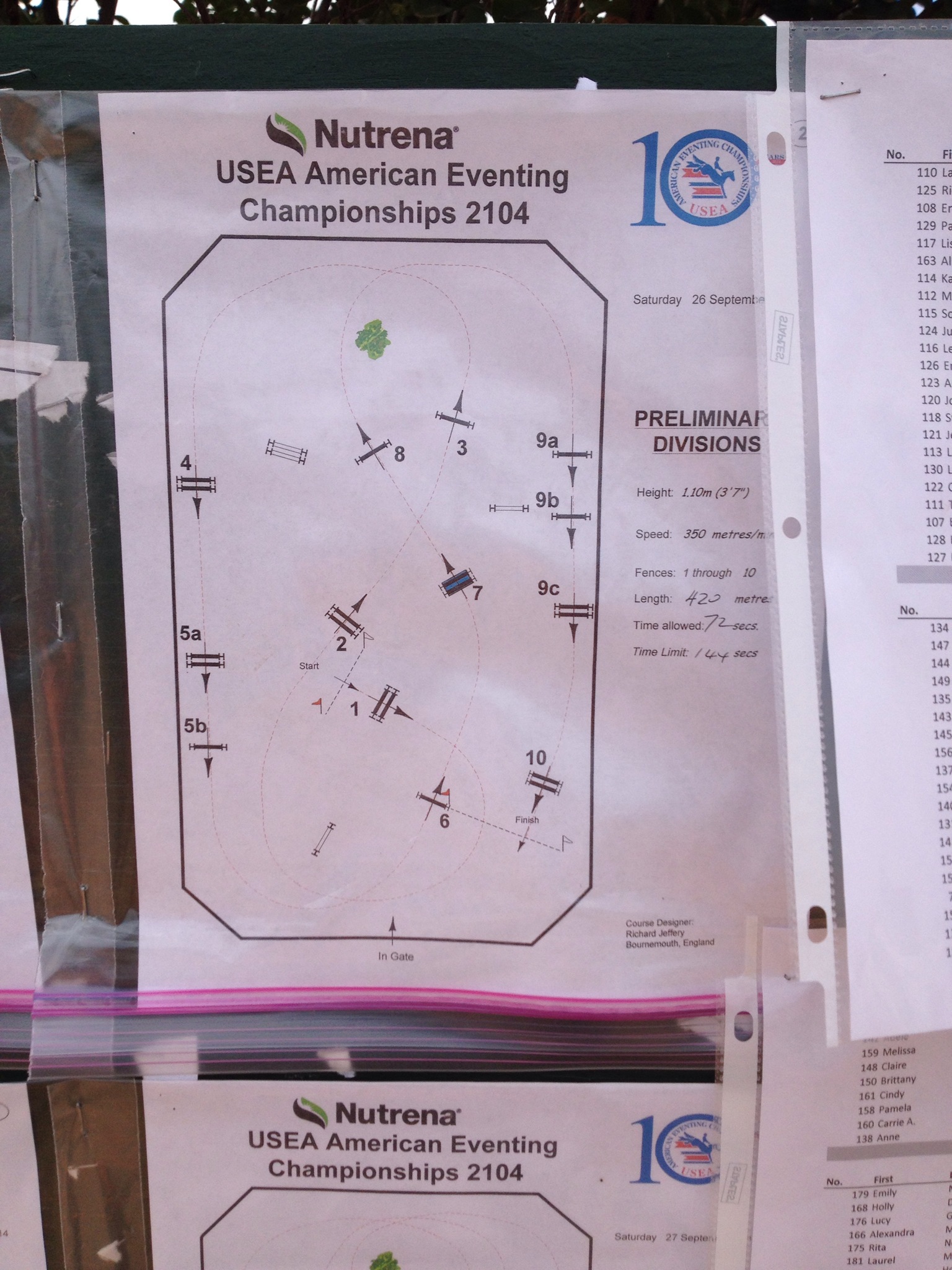
IMG_1339.JPGThe sj course looked like this, including a double, a triple, bending lines in both directions, a really lovely water-filled Liverpool and max fences as far as they eye could see.
Eddie warmed up beautifully, including mostly staying supple and having some nice lead changes in warm up. (Thank you Gerhard Politz, brought to Iowa by Dr. Stacy Thalacker. )
I warmed up with the help of John Staples and he reminded me about half halting within the rhythm of the canter and keeping my leg on at the base. I reminded myself about keeping my shoulders over my hips at the base of the fence and off we went when our time came.
Here is a shot of the course with the intermediate winners doing their victory gallop.

IMG_1341.JPG
I entered the ring and Eddie felt calm and cool. We picked up canter and went to fence one, the cactus oxer, and he jumped that and the next 4 fences well. He pulled 5b with a back leg, nice jump over 6, then pulled the rail at 7, the Liverpool, on to 8 just fine, then pulled 9a, but jumped 9b and c and 10 just fine.
The three rails are disappointing, but he was as supple as he’s ever been over a show jumping course. He landed on all the correct leads, he was rateable and felt powerful. All the rails were back leg rubs. I think he needs a little time off or maybe a radiograph of his hocks.

But he was brilliant and we had a great time. We finished third individually in the ATC and our team finished third, so we got a nice set of yellow ribbons. Picture tonight, I hope

The scoreboard says we only had 2 rails, but video, which I will post when I get near my computer tonight, clearly shows three rails. That’s eventing though. Sometimes you get a free rail and sometimes you taste the water in the water complex.
Right now we are watching them drag and water the ring before A show jumping. We saw Becky Holder’s fall on xc yesterday and we are glad she seems to be mostly ok, but sad to hear that “Can’t Fire Me” was non weight bearing on his right front. No Bueno.