Bonus!

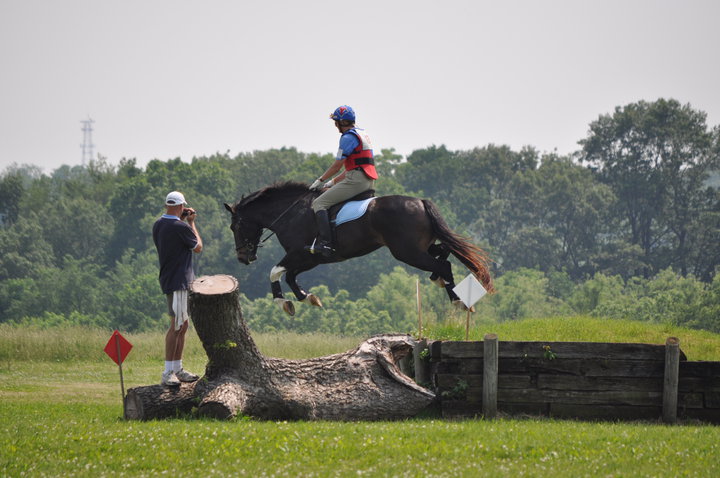
It is good to have some appreciable level of fitness when your horse does something extravagant and unexpected like this bit of air time... (Luke Klemm, Camie up. Jay with the video camera.)

It is that time of year when lots of people either a) put on the holiday 7 pounds and just learn to love their new shape or b) put on the holiday 7 pounds and go all manic with the workout resolutions, in this year’s case on January 3rd (Too hung over and/or tired on New Year’s Day and this year January 2nd falls on a Sunday, the resolution killer.  Who can start a serious workout program with that much lounging to be done?)

Last winter produced record snow for our part of the world and what started out as character-building in January, turned in to absolute will-shattering, never-ending tedium by mid-February.  It was absolutely impossible to ride with no indoor.  The horses had confined themselves to the 10′ feet around the barn because that was the only snow they could keep trampled down enough to walk around on.  I had to do something, so after I cleaned every closet and rearranged every room in the house out of sheer desperation for activity, Jay and I decided to join the local rec center which has some treadmills and a track, raquetball and basketball courts.  It was pretty easy to work out every day.  It was a big stress reliever and our bodies actually started to take on a some form of a shape, other than “roundish”.

As spring and summer came, we were plenty active around our place so we dropped our membership and picked it up again a week before Thanksgiving this year when the days started getting pretty short.  I don’t know about you, but I find it hard to go inside a building and work out when it is light and pretty outside, but when it turns dark early outside, I am attracted to a bright building with people who are actively not hibernating, like a moth to a deck light.

So I started working out and it bummed hard.  Of course I was comparing the fitness I had worked into last winter with where I was starting in the fall. I know better than to do that, but I went all momentarily stupid and did it anyway.  Active as we were over the summer, apparently the cardiovascular part of the equation is not challenged by mowing pastures and riding horses.  Who knew?  Jay joined in about a week after I started and hit the same wall.  By that time, I was pretty much back on track and, ok, I’m a naughty-bad wifey sometimes, so I’ll own that it was kind of fun to see him struggle as I had that first week.  Heh, heh.  For better or for worse for sure, honey, but if you are sucking wind and sweating because you procrastinated and I am fairly whizzing along with a light step and glow, I will not stop myself from smiling and cheerfully asking how your workout is going.  It’s in the fine print honey, really it is.

And there are days where working out still is a slog for me.  Such as, I can definitely feel a drag on my workout if I had more than one beer the day before.  Rats!  Or too much soda.  Double rats!  And some days it is hard to get started.  “My Ipod is out of charge.” “That dog walk I did today should cover it.” “My socks are downstairs in the dryer.”  The answers are “Your Ipod is optional.” “That dog walk was way too easy to be considered exercise.” and “Go downstairs and get them.”  Go.  Go.  Go.  Workout.  So I do.  We try to go every day, but it turns into 5 days a week.  Sometimes my teaching gets in the way, sometimes Jay’s work does.

I had no idea, though, that today was going to be a real payoff.  Today I got on a client’s horse to help square him up for an exercise they were having a challenge with.  I have really long legs and I didn’t feel like messing with her stirrup length, so I just flipped the stirrups over the horse’s withers and rode stirrupless.  I did a lot of canter depart work and lots of cantering for about 20 minutes.  It never occurred to me while I was riding that I really haven’t ridden much lately because of the footing and the arena project and I am therefore seriously out of riding shape.  As I rode, I was so focused on the horse that I didn’t think about that.  Then, at the end of the ride,  I was sliding off and I thought, “Ho, Nelly, that wasn’t smart, I am going to be really sore.  This might even hurt when my feet hit the ground.”  And when that is going through your head, it is a long, anxious way down from a 17h thoroughbred.

And nothing.  I felt great.  Not a twinge anywhere many hours later.  And no, I’m not 18 anymore.  All that stuff they say is true.  Just do it.  Or my personal favorite, “Excuses don’t lift up your butt.”  You don’t have to be perfect, you don’t have to train for a marathon, and it doesn’t have to take over your life.  My walking program is 33 minutes long.  I crank the heck out of the elevation on the treadmill for two minutes, then go back to a level that is easy for me for two minutes.  I do a little interval training repertoire that I made up.  I keep changing it as my body acclimates.  It is totally Camie’s made up fitness plan.
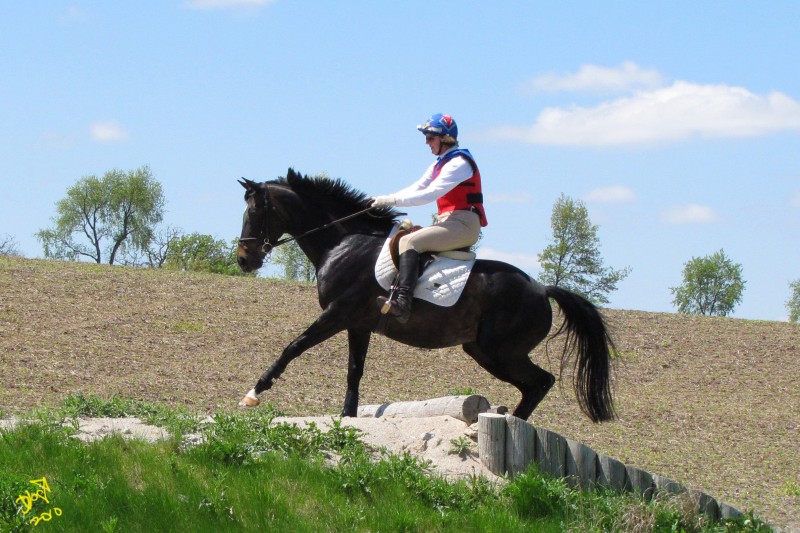
Effective, not terribly pretty... Camie on Derith Vogt's lovely mare, Carolyn

So, if you’ve been thinking about getting in a workout program, go on, do it.  Do whatever works for you.  Go all crazy fancy, swim on Tuesdays, join a spin class, get all yoga-ed or keep it simple.  Like cross country riding, a workout program doesn’t have to always be pretty to be effective.

Solstice lunar eclipse

Long-legged turtle-necked horses of the arctic

Winter is a great time for a lot of things but, quite disappointingly, naked pagan dancing is not one of them.  Cold weather and Seinfeldian shrinkage notwithstanding, tonight is the best opportunity for naked pagan dancing in winter in 372 years.  Why? Because tonight, starting at 00:33 CST a lunar eclipse will occur on a solstice.  That hasn’t happened since 1638 – pretty cool. NASA’s page about it is excellent.  My goodness, Dr. Tony Phillips is a scientist who can write concisely and understandably, and apparently he knows some good graphic artists.

So what do I plan to do with this information?  Well, I’ve been watching the visible satellite at intervals today to see if there is even a chance at a clear sky tonight. Visible satellite images are for total weather geeks, as we know that the usual satellite images that you see on television are infrared (IR) satellite images, which are really an indication of the temperature of cloud tops, which are then represented by differing shades of white.  Pooh pooh, IR is not real data.  Visible satellite imaging is ground truth.  Ok, cloud truth.  However, weather geek strategy falls to dust when the sun goes down, since visible satellite is just that, a visible picture of clouds taken from a geosynchronous satellite 36k km above the earth.  When the sun goes down, the clouds are not visible.  Wah.  But I digress.

Anyway, there appears to be a break, or at least a thinning of the clouds that may pass over our house in central Iowa just around the right time.  So, here’s my plan.  Set the alarm for 00:25, put on boots and a big coat over my jammies and go out on the deck and watch the earth’s shadow take the first small bite out of the bright white disk of the moon.  Then I’ll probably watch that for a bit.  Snap a few pictures.  Then I’ll get sleepy and go lie on the couch for a few hours.  Then the alarm goes off again at 0300, when I will get up and put on really warm clothes and take a few pictures of what should be a blood red moon.  I’ll go out and see what the horses are doing.  I love any excuse to walk out to the pasture  in the quiet of night and be with the boys.  Maybe they’ll be in the barn, where they can come and go at will.  I love that they’ll probably be awake as day, the same way they are dozey as night at 10 a.m. everyday.  Their sleep cycles aren’t like ours.  They don’t stay up 16 hours straight and sleep 8.  They like it best to stay awake 3 hours and sleep 30 minutes or something.  I once had an off track thoroughbred who laid down in his stall and fell into a deep doze between dressage and xc at his first show.  He popped awake for xc and galloped like a metronome around the course.  King of the catnap.  Crazy.

With all the puttering around tonight, maybe I’ll be a little tired tomorrow.  Maybe I’ll have to sneak off for a catnap.  I guess I’ll be sleeping like a horse.  Enjoy.

We’re all alone, together

My professional life is a double one, that is, that I spend half my working time with horses and riders, and half my time working with computers and research scientists.  When I’m not covered in horse hair, I work at Iowa State University in the Office of Biotechnology.  Here’s our website, which is a primary responsibility of mine.  I spend a lot of time listening to exponentially-intelligent people who have invested their time and talents in a formal education system.  Then it is my job to make some of what they say to me understandable to real people.  I make very good use of a digital audio recorder because there is no way I could get the details of what they say down on paper as quickly as the words flow from their genius mouths.  It is perspective-changing, empowering, and sometimes daunting to be around such sophisticated skill.

And so I got to thinking about how most of us learn to ride.  For me, there was very little formal education about it.  I flopped around on a wonderful black and white pinto shetland pony, playing cowboys and indians, “teaching” him to drive (that very humbling and funny story at another time), had a few lessons here or there, went to 4-H meetings and learned whatever I could, read a lot and basically trial-and-errored my way through it until later in my career when I could commit to some serious clinics with some teachers with very sophisticated skills.

Recently, I’d been thinking that my meandering path to horse competence was somehow flawed.  It lacked the discipline of the University-trained Ph.D., even though, by now, I have done enough independent study to have earned a Ph.D. in my chosen field.  But then I saw an article yesterday about Diana Pounds, who manages the Iowa State University website.  Managing a major university website is a huge responsibility.  It is the face of the university to the world on the internet.  It will be looked at by some of the brightest minds at the U’ and by thousands of prospective students and parents who may or may not choose to spend their tuition money as a result of what they see on the website.  Donors peruse it.  It is a big deal, and it is created, maintained and critiqued by a sea of people who are classically educated.

I was thinking about that the other day when I read an article written about Diana’s work.  From the article:

And she’s well acquainted with plodding her way through unfamiliar cyberspace, being totally self-educated in the ways of the Web.

“Lots of us are self-taught, because we had to be,” Pounds explained. “The technology sprang up, and we all had to learn to do HTML.” Pounds’ curriculum included a variety of online “how-to” manuals, as well as “20 to 25” books on programming and Web design.

So, Diana, then, is producing a web site  at a very high level, with millions of dollars on the line, with no formal training to do it.  No Ph.D. of web design.  And people look to her for help and answers, and she delights in her work and is great at it.

Learning to ride horses for many of us is like that – an adventure in independent learning.  Just you and your horse figuring it out.  Because most people learn independently, they don’t have the benefit of being able to say to themselves or others, “Hey, I can do this, I’ve got my Ph.D. for goodness sakes.”  That sort of external validation is a daily boost to the confidence.

But as riders, we can earn external validation every day.  Horse are perfect mirrors of their riders, just like a computer is the perfect mirror of its input.  Garbage in, garbage out, of course, but also, great input can result in great output.  Put the HTML in correctly and the page happens.  Miss a letter of the code and some really wacked errors will happen.

In the case of horses, if the horse understands what the rider is communicating, the horse’s expression is relaxed and happy and he performs his task with ease.  Good input creates good output, just as in the case of learning to make a web page.  Nonsensical input to the horse, even something as minute and invisible as rider tension, can result in bad output.  When you get the riding right, just like getting the HTML coding right, you get something which is a pleasure to experience.

So ride on, have some success, and be fearless, make mistakes.  Mess around with the code.  See what your horse says to you and try again.  You have a perfect mirror right there in your horse – your personal professor of external validation.

Cheer up

One of the tricks to being the Horsitivity Girl and keeping a positive attitude, is dealing as well as I can with days that are not so terrific.  Today is not a bad day at all, Jay and I are well, all the horses are well, so the basics are covered.  But I am annoyed with the mud that is part and parcel of the arena construction project.  This can really drag on a person as my paddock boots are always dirty and heavy with mud.  My barn is full of mud.  The footing is terrible everywhere, so I am limiting my riding to only the absolutely necessary rides, which bums me out.  It is overcast today and there is a long winter ahead.  All these add up to a slight melancholy for me.  But it is ridiculous for a person as fortunate as me to whine, so for days like this I always keep something easy and fun to do that cheers me up.

My cheerup for the moment is the helmet cam video of Peter Atkins riding Henry Jo Hampton around the WEG xc course.  Peter has a fun accent, he talks to his horse like he loves him, and watching the video generally reminds me of all that is effortless and fun and why horses and the people who love them are great.  The sort of growling you hear is him saying “Henny!”, the horse’s name.  He also takes out the flag at the third to the last obstacle and doesn’t miss a beat, just lands it and takes the option.  Love it.  Enjoy.

Learning sitting trot

Sitting trot can be a pain in the butt, and a pain in the “front butt” too.  The bumping that accompanies learning to elastically sit a horse’s trot can be a real trial, and one you don’t probably choose to discuss with your non-horse friends on girls’ night!

The first inclination when things get painful in the nethers is to blame the saddle, and there are probably some small minority of saddles that are so ill-fitting as to be the source of the problem. However, if you’ve tried several, many or myriad saddles and you can’t find one that is comfortable for sitting trot for you, the one constant is not the saddles!  For fun, let’s just entertain the idea that it might be technique rather than saddle.  My Dad’s voice rings in my head: “It’s a poor workman who blames his tools.”

What is happening to produce discomfort?  When a rider’s back is not relaxed and elastically following the movement of the horse, there has to be a bump between the moving thing (the horse, going up and down and forward) and the still thing (the rider, who wants to be still relative to the horse, but she thinks she can do that by holding herself still through the use of rigid muscles. “Still relative to the horse” in sitting trot means both keeping her hips and shoulders over the center of the horse at the front of the saddle as he moves forward (relatively easy for many), and elastically absorbing and releasing the energy of the upward bound and downward release of the trot (relatively difficult for many).

Picture a person learning to dribble a basketball.  At first, their hand slaps the ball down with an audible bump.  Over time, the person learns to catch the energy of the ball bouncing off the ground and then smoothly return and even re-direct that energy down.  Soon the person can dribble the ball anywhere she wants.  There is no bumping against the ball, only catching the energy of the ball going up, in an open, relaxed and elastic hand,  and then releasing the energy back down.  This accepting and releasing of the energy coming up and going down is what we do in good sitting on trotting horses. The horse is like the ball sending energy up in his bounds up and forward and releasing it in his return to the earth. In good sitting trot, the tripod of your pelvis is engaged with your lower back to produce the relaxed and elastic catching and releasing of that energy.

Most of us think we should be born knowing how to sit the trot, so we expect it to be immediately effortless.  It is afterall, just sitting and we do that all the time.  (More correctly, riding sitting trot is active stillness.)  And it looks so fabulously easy when some riders do it.  Because people tend to think that a connected sitting trot is their birthright, they get in there and wing it, and unless they are of the 1% to whom it actually IS their birthright, they find themselves surprised to be bumping the saddle with their pelvis somehow (some with the back of the pelvis, some with the front) and it hurts – just like slapping a basketball with your hand is not pleasant. Except with a basketball, we would be thought very silly if we blamed the ball for hurting our hands while we are slapping it!

To compound the problem, without patient development of the sitting trot skill, there is a natural tendency to tighten the thigh and back to defend oneself against the bumping that develops.  This keeps the pelvis tensely tilted up off the saddle, which stops the bumping, but it disqualifies the possibility of real connection and influence on the horse, and, further, encourages stiffness in the horse, which then makes the gait harder to sit!  It is a vicious cycle that can be circumvented with knowledgeable help and patient attention.  Here is my blog about regaining the sitting trot after I lost it when I shifted my sacrum.

Watch George Williams (love his riding.  Yeah, I know.  I am kind of like John Madden talking about Brett Favre, but stay with me here.) in sitting trot in this video.  Try not to be distracted by the gorgeous horse or surroundings.  Look at his pelvis and lower back.  They are moving.  A LOT. Riders have to be fearless and elastic in sitting trot.  You can only be those things when you actually have help in learning to sit the trot by slowing things down and being patient with yourself while you do it.  The payoff is uber cool.  Real connection with the seat in sitting trot is a cornerstone to really good riding.

Velour Horses

Tomorrow is supposed to be very windy, with rain.  So today we are getting as much done as we can outside – riding as many horses, raking leaves, and it turns out, late night dog walking in the pasture.

Even though the moon is nearly full, it is dark outside tonight.  The cloud cover has overpowered the luminosity of the moon and a southeast breeze blows forebodingly. But it is still mild enough out for a walk and we take the three dogs out.

Dory the wonder pup

Dory, who is 3 months old now, is a new addition to our family.  She was mostly ignored the first 8 weeks of her life, so she arrived fairly skittish.  Peppa, the Newfoundland, immediately understood the situation and took Dory under her wing, showing her all the good hangouts at our place, where varmints live or even momentarily passed by in the last 6 years, and that life is good here.  Now we are doing our part to show Dory that people are good too, thus the late-night pasture walks, clicker training at the Animal Rescue League and patience when she occasionally gets scared of something and runs from us.  That part makes us both very sad.  It is hard to not take it personally when a puppy runs away when all you want to do is comfort her.  She is getting much better at coming to us when loud noises and scary things, which are many to her, happen.  She is starting to see us as protectors and we are delighted.

Thus the pasture walk in the dark tonight.  Another opportunity to bond, to show Dory that we are fun to be around.  About 400 yards into the pasture, after we had joked that if we didn’t walk into a jump it would be a miracle with our lack of visibility, a silent horse form appeared, white stockings announcing the presence of Elliot.  He stood quietly as we walked up and we petted him while he lowered his head  and accepted our affection.  I moved back along his neck and over his shoulders, petting his developing winter coat  in long strokes.  I was amazed with how smooth and silky it was.  Soft and springy as spring grass, and nearly as sweet smelling.  He turned and looked at me with his big soft eyes as if to say, “Did you forget how sweet we are?”  I had.  These cooler days I have been wearing gloves most of the time, and in a little bit of a hurry here or there, so I hadn’t petted a horse barehanded and really paid attention to the luxuriousness of a horse’s coat in, well,  a while.  I just hung out a few minutes and really felt his coat while the breeze blew and the dogs and Jay played.

I had intended to do something nice for one animal, to spend some time with Dory, and I was thereby blessed with a reminder of the magnificence of experiencing something so familiar, but altogether new.  Glad I got off the couch.

Stopping nit-picking and George Williams

Lots of things going on today.   First I rode Bino for his daily Cowboy Song walk hack around our little valley.  The song that popped into my head today is, “I know where love lives.”  I don’t know where these songs come from, but I go with it.  If you’ve been reading, you know that he has navicular and we are taking it very easy with him and enjoying what we can do together.  Taking him on these hacks has a whole other dimension of enjoyment that I’d forgotten about–riding just to ride.  Since I train horses, I had gotten into the habit of correcting any behaviour that could potentially get the horse in trouble with me or his owner in the future.  Bino is in a different situation, though, so I get to let the little things slide.  When I brought him to the mounting block today and swung a leg over, he didn’t wait until I’d entirely picked up my outside stirrup before he walked off.  Usually I would correct this.  Today, I just let it slide.  When we were walking through some tall grass on the ride, he grabbed a mouthful on the way by.  So what?  No worries.  I let him munch away.  This must be what it is like when a mom realizes her kid is an adult, that she doesn’t have to, nay, shouldn’t, correct every last faux pas, but rather let the child live his life as he would like.  Some moms never get to that point, to the constant annoyance of their adult children.  Today I got to be the mature parent with the grown child.  I got to enjoy his personality, strengths and faults, with no judgement, and totally enjoyable for both of us.  I didn’t see that coming.  Sometimes, on these beautiful autumn days, in the soft footing of the soybean fields, I think, “oh, he’s alright, maybe we are making the wrong decision.”  But then, almost immediately when I think that, he trips as he often does.  Since his feet hurt, he doesn’t pick them up very high, and therefore often trips.  I also think of the radiographs and the coming frozen ground and the painful prognosis.  I pull my mind away from that and I let him munch grass, and pat his thick black neck.

Then it was on for a ride on Elliot.  You may recall a few weeks ago, that I found my sitting trot after it had left me for a short hiatus.  (Ok, 6 weeks doesn’t seem short at the time…)  Well, it turns out I didn’t really have it back yet.  I had it back for working trot, and I had it back for Eddie’s trot, but I didn’t have it back for Elliot’s extravagant warmblood trot.  I could only sit that well for about 5 strides, after which I would be left unceremoniously behind like some turnip off the wagon, and I would have to resort to posting to not be too much of an annoyance to Mr. Floaty Trot!  But there is no crying in baseball or dressage (ok, there probably has been plenty of crying in dressage, but a lot of it is hidden behind post-ride wine and cheese clutches) so I had to figure out what the real problem was.

So I pulled out pictures of my riding to see what was going on.

I have no ego about my riding.  I am only as good as my horses say I am, and they are pretty clear communicators.  I’m not trying to be better than anybody and I know I am not as good as some.  So, when I look at pictures of my riding, I am pretty ruthless, and it doesn’t bother me in the least because my heart is in the right place.  Intent is everything.  I had to explain that because when I look at this picture I think, “Overall, not a bad pictures, but 1) more inside leg, less inside hand, and 2) let go in your back, let your pelvis come forward and everything would straighten out, silly.  😉

Ok, so the first comment is fairly self-evident.  If you’ve ridden with a dressage instructor and not heard “Let go of the inside rein!” either you are a riding savant or your instructor is busy texting in an Ebay bid on Totalis tail hair during your lesson.

The second comment is more subtle.  “let go in your back, let your pelvis come forward and everything would straighten out.”  When we ride, we should sit on the tripod of our two seat bones and our pubic bone.  In the picture above, I am sitting almost solely on my seat bones, because my back is slightly braced.  If I would let go on my back, which is to allow the lower back to come forward (and the belly button to come forward), the pubic bone would come down to support my weight, much like the front wheels of a landing airplane come down after the back wheels touch down.  When all three sets of wheels are on the ground, things are very stable (and the passengers are much happier!).  When the rider is properly balanced on the tripod everything else “straightens out”.  By that I mean that the legs and the upper body may become correct.

Landing gear down. Why George William is my riding hero.

Here is a picture of George Williams who always has the landing gear down.  You might remember that I ran into him at the WEG.  He’s a very kind person too.   Most excellent.  In this picture and a million others, he has beautiful position in his upper and lower body because the center is correct.  Now, I am not saying I am a bad rider, but I’m saying George is a great rider.  If you compare my photo with Geo.’s, you’ll see that he is better able to stretch down in his leg and his upper body is much more solid than mine in that picture above.  Because I am not elastically  following the motion of the horse’s back in my lower back above, I am forced to bring my upper body forward to compensate.  Because Geo. has allowed the natural curve of his lower back to act like a natural spring to keep him wholly connected in his seat to the horse, his upper body stays nicely aligned over his pelvis.  My leg isn’t bad, but it appears jammed up into my hip socket.  My stirrups aren’t too short, my pelvis is at the wrong angle.  Geo’s leg seems to have an elastic connection to his hip.  All these differences are pelvis angle.  Front landing gear up vs. front landing gear down.

So I was playing around with that the last few weeks trying to regain the ability to sit Elliot’s fancy lengthened trot.  When I focus on relaxing (this is an oxymoron.  One can no more focus on relaxing than one can turn their head to test their peripheral vision.) my pelvis and to let my lower back move with the horse rather than sitting against it, I can fairly easily sit his lengthened trot for long periods of time.  The trick is in not resisting — in reminding myself to flow with the horse in my lower back.  So I channel George a lot.

Training, simplified

Piaffe

When Jay and I were watching dressage at the WEG, we were using the headsets in which a commentator was, well, commentating.  I don’t know if this happens to you, but sometimes a particular turn of phrase will have such an undeniable “truthiness” (oh how I love that word) to it that I find myself putting everything else immediately aside to think about it.  The commentator was acknowledging a particularly beautiful piaffe in an afternoon of piaffing excellence.  She said,

“When you train a horse you have to do two things:  You have to teach him the mechanics of what you wish him to do, and then you have to teach him that he is good at it.”

Upon hearing that, I didn’t really see the rest of the test, though I was looking.  It was like a lightning bolt hit me, and I sat there, stunned.  That one sentence encapsulated all that I do with horses.  A trainer has to know the correct mechanics of any skill she is trying to teach (what are the footfalls of canter?  How does half pass start?  How does a horse arrange his legs in all stages of a jump?).  The trainer also has to know when the work is correct, or even close while they are learning, and communicate that to the horse.  Congratulate him, even.  When the horse gets his paycheck in praise for doing a thing as we wish, pretty soon he likes to do that thing.  When he likes to do that thing, he performs it with increasing confidence, which, if nurtured, becomes brilliance.

So the horse piaffing with joyful brilliance in front of us that day had mastered the mechanics of the movement, and he clearly knew he was good at it.  It was a joy to see.  Now that’s training.

Cowboy songs


Bino


I took a client’s horse in to ISU Veterinary Medical Teaching Hospital today to have radiographs on his front hooves.  He’d been pointing one front leg or the other intermittently over the last few weeks and finally we had to know what was going on.

The radiographs indicated moderate navicular and the prognosis is continuing deterioration and discomfort for the rest of his life.  I’ve had some second-hand experience with navicular disease and I know it isn’t fun for horse or human companion.  I’d suspected navicular and talked with my client yesterday about our options should that be the diagnosis.  We agreed that donating to the vet school for educational use for the students would be an option that at least would yield some benefit to society.  So when I got the news, alone with the vet in front of the glow of the radiographs on the lightbox, I considered a moment and told her of our wishes.  She agreed that navicular can be a difficult road and said she had to talk to administration to see if they were in need of horses right now.

She went off, and after I wiped the tears from my eyes after a sob, I went over to Bino’s stall and rubbed him in all the places he likes to be rubbed.  It isn’t fair, this business of good-minded, gentle souls being placed in bodies that hurt them.  But I didn’t cry around Bino.  I talked in my usual low voice and fed him cookies from my pocket.  He doesn’t need hysterics, he needs a friend to take his mind off his aching feet.  And a real friend to make the hard decision to take the pain away entirely for this lifetime.

The vet came back and said that there was a class starting in 2 weeks where the 4th year students would be learning catheterization and ultrasound techniques.  Since Bino is a good sort, he was a candidate.  They would administer pain killers so that he would not hurt in any way as a result of their occasional misfires in the learning process.  At the end of the term, they would euthanize him.  This wasn’t quite what I had envisioned.  I was thinking of them doing a practice colic surgery and just not reviving him at the end.  But I could get my mind around this plan too.

Difficult decision made, sniffles abated, but the class doesn’t start until October 27th, two and half weeks from now.  He could stay at the vet school or I could take him home and bring him back then.

I brought him home.  We’re going to have cookies.  We’re going to use bute.  We’re going to trail ride every day possible between here and October 26th, when I have to deliver him back to Ames.  I am going to continue to be his pal, even though he is really “only” a training horse to me.  His mom lives pretty far away and may come to see him, but she won’t be here daily.  I’m going to smile and notice butterflies and watch geese fly south from his back during the next two weeks.  I’m going to sing cowboy songs and let him be my hero horse.

And I won’t cry around him.  When my dad was terminal he seemed to really be uncomfortable when people would cry because of his situation.  Of course.  They were thinking of their loss, not really of him, or they’d have brought cookies or board games to cheer him up, even if only momentarily.  So I made him a funny fake news show about John Deere tractors at the television station I worked at during that time, and brought it to him.  He was a JD salesman.  He loved it.  He forgot his troubles for a moment.  It made him remember who he was and made him laugh.  There was time for crying after he was gone.

And the same is true for Bino.  We’re going to put on the big girl panties and enjoy these two weeks with walks in the soft ground of the harvested soybean fields, and I won’t cry in front of Bino.  There’s time for that later.

2010 WEG Eventing Course Walk With Boyd Martin | The Chronicle of the Horse

I just read  the 2010 WEG Eventing Course Walk With Boyd Martin | The Chronicle of the Horse. and I’m delighted to learn that I’m not the only one who walked around that course thinking it looks big!

I’m back in the tack at home now and it is really good to be on the back of a horse again.  We arrived home about 4:30 last night and Jay and I instantly got the major things out of the car and went immediately outside to enjoy the beautiful evening.  I hopped on Eddie and had a wee gallop  in the newly harvested soybean fields.  Great footing.  Nothing like a gallop on a 17h thoroughbred to clear the mind after a 10.5 hour car ride.

Then I swung a leg over Elliot the wonder warmblood.  A friend dropped in during my ride and we we talking while I was warming him up in walk, then some walk lateral work and then into trot.  I was emulating the quiet hands and relaxed backs of the riders I’d been watching for the last two days.  When we picked up a trot, my friends said, “Wow, even the first step was elastic and lovely.”

I don’t think I could have dreamed of a nicer thing for her to have said.  I’ll keep working.  I’ll keep channeling Edward Gal and Steffen Peters and remembering that even Boyd Martin thinks the course looks big the first time he looks at it.