Look what I found!

Our friend the SI joint

So I lost my sitting trot.  I lost it honestly, by, as my niece would say, “being chucked from a horse” when he rapidly decelerated in front of a jump.  I injured my sacroilliac joint which, frankly, is literally a pain in the a$$. Until you injure your SI joint, you won’t fully appreciate its role in your happiness and comfort.  A pair of happy SI joints makes for a happy girl, ok, that’s just me lately, but I’m just sayin’, be happy if yours work right.

Now that I am mostly recovered, thanks to rest, chiropractic and a very understanding massage therapist, I am back in the saddle.

This is not my butt, but that was definitely the owie spot.

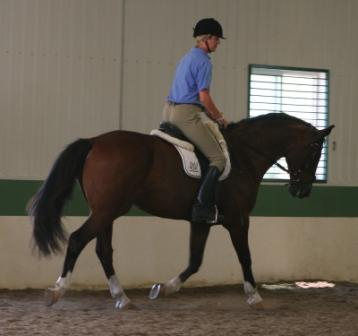
The difficulty in riding again when I was first back in the saddle was what you would expect – a very strong feeling that I did not want to be jostled or fall off.  But that passed in time and then I started getting back to the more technical challenges of riding.  The most distressing thing was that I’d lost my sitting trot. Rats.  Sitting trot is one of my favorite things about riding.  Oh, wait, everything is my favorite thing about riding.  Well, you get the idea. Sitting trot was easy and fun.  The first part of the video below is a good example of fun in sitting trot with Eddie the Wonderful.


Let it be noted here that I am a bit of a details person about my riding technique.  The more I learn about what works and what doesn’t, the more I realize that riding is a game of centimeters, not even inches. Probably, for those folks who ride at a very high level, it is a game of millimeters.  The angle of the thigh, the use of the abdomen, everything, all very precise without tightness.  The difference between what a horse responds to and what he interprets as physical chatter is very subtle indeed.

So, when I say I lost my sitting trot this means that it simply wasn’t as connected as it was before.  There wasn’t flopping about or major tension, but the connection I had with my seat  before the SI injury was far superior to what I was producing after the injury.

I decided not to get emotional about it (because I sure was tempted to go down that path.  You know the one, the hairy gnome in your brain says things like, “Oh, you’re just getting older and it may not come back” and icky things like that) and just go the scientific exploration route.  Dr. Spock goes riding.  So I started to explore what I was doing differently to make the seatbone connection be intermittent rather than full-time.  The first thing that caught my attention was that my legs were not as long, I was pulling up from my hips a bit.  Focusing on stretching through my leg was helpful, but even after a day or two of attention to that, it was clear that was not the entire answer.

So I took some more time to really notice what my body was doing that might be getting in the way of real seat connection.  Not surprisingly, I was holding in my lower back.  Duh, I know, I should have figured that out right away, but I was a little too close to the problem to see it.  Since the SI joint hurt so much less, I hadn’t really entertained the thought that it still hurt some and I was protecting it.

When I asked my kind horses to slow down their trots until I could learn to relax and follow again, things became easier.  I did a lot of short periods of sitting trot, interspersed with walk and canter breaks, including 2 point in all gaits.  I was as kind to my body as I would be to a horse I was rehabilitating.  Lots of breaks, exercising only to slight fatigue of the injured area and taking every other or third day off.  And whaddya know, it works.  Tonight I trotted around on the wonder warmblood in all his fabulousness in lengthening and we were connected again.  It just fell into my lap.

And once again I realized that when I pay attention to the details and get them right, big good things come in their natural course.

Playful, playful

Fabulouso and Camie at the Radnetter clinic

This weekend’s horse adventure was to ride in the Herwig Radnetter clinic at Wildwood Hills put on by the Iowa Lipizzan Association.  I’d heard that Mr. (Herr?) Radnetter, of the Spanish Riding School (SRS), was an excellent teacher.  He’d been teaching annually in our area of Iowa for the last three years.  My friend Susan, the immutable force behind Catalpa Corner Charity Horse Trial, proclaimed one day that I needed to ride Fabulouso in the clinic.  She said it was time to see if I could make a foray into Real Dressage Land, continue to expand my education (an addiction of mine), and perhaps not have the entire local dressage community be astonished that any horse allows me to swing a leg over them.  Bottom line is that I pretty much do what Susan says, so I signed up for it.  I’d have her horse, Fabulouso (aka Elliot or Fatboy), under tack.  He classes up any joint, so I felt that if worse came to worse I could simply fade into the background and count on the mesmerizing effect of 1,000 years of German breeding oozing forth from Elliot’s genetic code.  That was my plan, and he is always good with being adored, so we were all systems go.

German breeding on display and the monkey-in-the-tack basking in the glow at the Otter Creek Horse Trial:

I should explain about the “Fatboy” name. I’ve always liked off track thoroughbreds, so I’ve gleefully decorated our pasture with them and taught them all sorts of fun games, like eventing, foxhunting and dressage.  Physically, the thoroughbreds all run a little lean, of course.

Then one day Susan suggested that I teach Elliot to event.  So he came to our house for the winter.  Hanovarians, to say the least, are a bit easier keepers than the usually high-metabolism off track thoroughbred.  Elliot arrived in the autumn, just when we were starting the transition from pasture to a lovely part grass/mostly alfalfa hay mix for the winter.  All the thoroughbreds stayed in work and held weight beautifully through the fall and winter months.  The warmbood, Elliot, stayed in work as well, and held weight spectacularly, shall we say exponentially.  That winter in the frozen tundra of our pasture we had a group of fit, fuzzy, slightly angular tbs and one grinning bay marshmallow with whiskers.

Susan shows her love with food.  Every time I visit her house, I have to go on a week-long workout program to mitigate the effect of the deliciousness she provides everyone within her sphere of influence.  With this mindset, she fretted over Elliot’s weight all winter long, since it was one of the first winters he was going to be in significant work.  The emails went back and forth.  “Is he holding weight?”  “Yep, just fine.”  <two weeks>  “How’s Elliot’s weight?  I could bring over some hay.”  “Lookin’ a little pudgy.”  <three weeks> “With all this riding, is he doing ok with holding weight?”  “Ok, Susan, I’ll fess up, around here we call him ‘Fatboy’.”  “Super!”

Susan Brigham's Fabulouso, aka Fatboy aka Elliot.

Time passes, we do some prelim level events, the AECs, develop a partnership and represent ourselves pretty well.  So now Fatboy and I were riding in the Herwig Radnetter of the SRS (still pretty cool to me) clinic in front of much of the local dressage community, who, I suppose, consider me a bit of a wild child eventer/foxhunter sort, which I would have trouble effectively arguing in any court.  However, truth is, that I am able to do those things reasonably well because I base all my training in dressage principles.  So the foxhunters think I’m a dressage queen, and the dressage people think I’m a foxhunter wildthing.  All good, call me anything, just don’t call me late to go riding.  As an aside, you can read a fairly hilarious “she must be from another country” critique by Geo. Morris about this picture.

The lesson with Herwig Radnetter was great, but not in the way I expected it to be.  He talked about all the things that you’d expect-position, engagement, connection, a cajole about the fact that I didn’t clean my tack that week (guilty!), rhythm, balance, transitions and more.  But the one concept that stuck in my head was ‘Playful’.  He was saying this in reference to rein contact.  In that lovely light Austrian (German?) accent with a faint smile on his face.  When he said it I didn’t know precisely what he meant, as in what exactly a Playful thing to do with the reins is.  But I did know the feeling of Playful, so I went with it.

“Rounder, rounder, rounder and playful with the reins”.

I was getting somewhere with it and we were all three moderately happy with the work, but Herwig said that he would ride the horse.  Interestingly, he didn’t ask.  I didn’t mind, so that worked out well for both of us.  He got on and even though Fatboy is mesmerizing, I focused on what Herwig was doing with his rein contact.  He was doing all the things we know already to do: still outside hand, active inside leg (but I note even the leg was Playful but without the prodding busyness we see sometimes).  The inside hand was also still for the most part, but there was definitely a give and take in showing the horse what was appropriate.  At some point during the lesson he said the ubiquitous “We do not pull” which we’ve all heard a hundred times.  But now I finally understood that we can take momentarily, but the big brother of “take momentarily” which is pull, is not the answer.  “Quicker and smoother and the release is The Thing.”

This can be an epiphany for riding.  To know that you can take, but you can not pull.  To be playful.  Think of two kids playing with a toy together.  It is fun when one interacts with the other by good-naturedly and momentarily taking the toy toward himself with a smile and a sparkle in his eye.  The other kid laughs and takes the toy back toward himself and the first kid acquiesces because he knows it is a game and the interaction joyfully continues.  If, however, one kid grabs the toy with a stern expression and pulls it toward himself in an effort to overpower the will of the other, resistance ensues.  Whether the two interactions, which are essentially the same, are resistant and angry — or flowing and joyful –is a matter of intent.

Rounder, Rounder, Rounder, Playful, Playful. When it echoes in my head, it comes out as lovely gratitude in my horses.

Do you have scripts in your head that show in your horse when you ride with them in mind?  What are they?

Best. 52.8 penalties. Ever

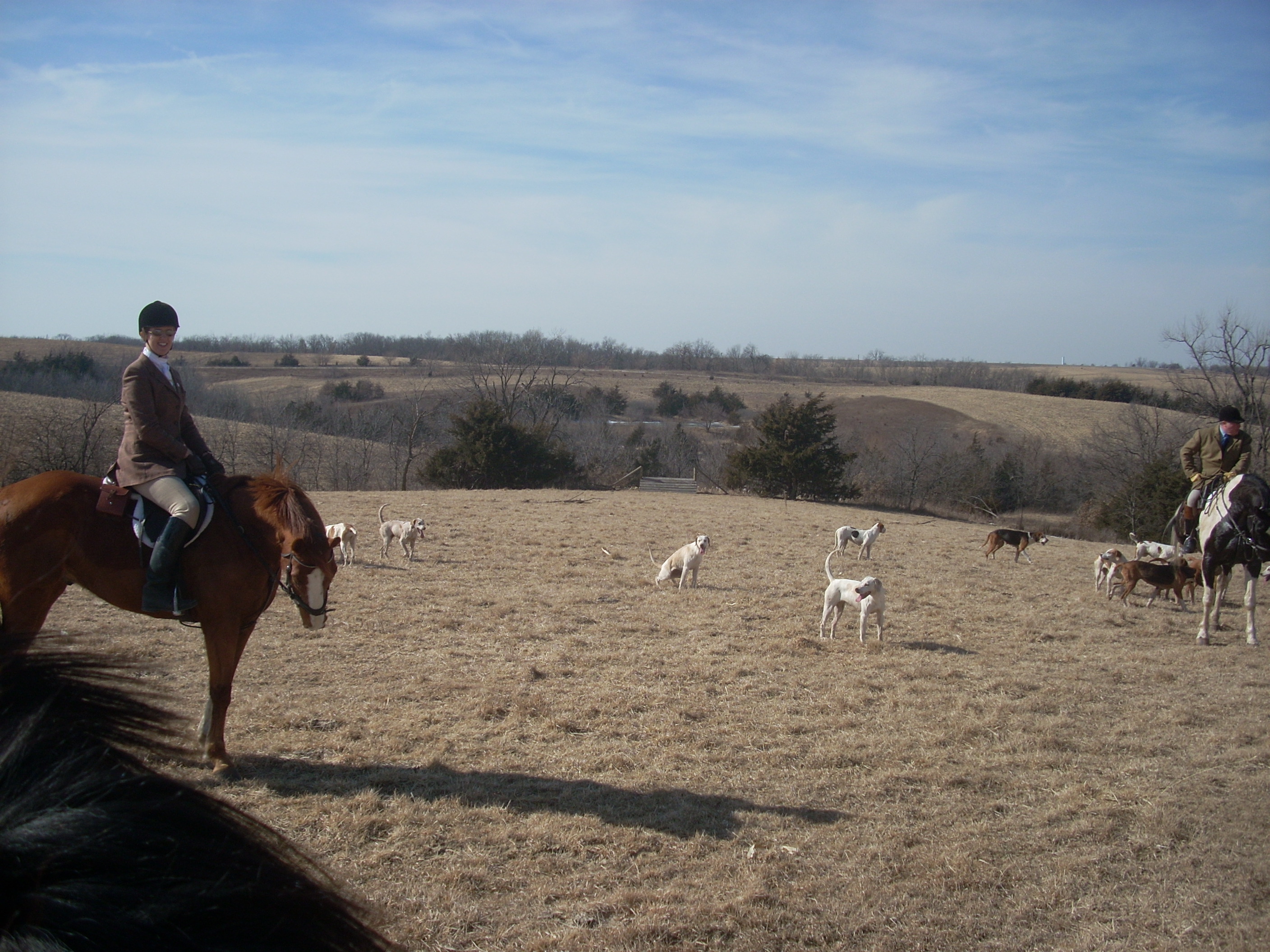
Sammy and I at a check on a hunt in TMH's beautiful Grand River fixture

Catalpa Corner Charity Horse Trial had a fairly tough training level xc course over the weekend.  I had entered my developing horse, Sammy, in his first horse trial there, and walking the course I felt like we probably were prepared, but that it would take some riding to get it done.  Sammy and I had done a lot of foxhunting together, which always makes me feel confident.  I really get to know horses when I foxhunt them for a season or two.  They say foxhunting is like war, but with only half the danger.  The experience of going through the excitement and the tedium of live foxhunting bonds us like men who spent time in foxholes together-we’d never ask the other to do anything we wouldn’t do for them and we’ve got each other’s backs.

We’d also taken care of the technical side of things, with dressage, xc and showjumping schooling of course.  We’d done a schooling horse trial at another park at training level and done very well.  So, I thought we were prepared and didn’t lose any sleep on Friday night.

Saturday morning’s dressage went fine and after a few hours’ break we were warming up for xc.  Sammy’s not much for show nerves, and galloping all over God’s creation on a hunt with 30 of his closest horse pals all winter makes the xc warmup chaos feel like old home week.  So, having warmed up, we trotted down to the start box.  Since this was only his second horse trial (the first being the schooling horse trial a few weeks before), he stood in the start box without much of a clue as to what was coming next.  So I enjoyed the quiet time, which I know won’t last.  When he has a few more horse trials under his belt, he will know exactly what a start box means and start revving up the engine there.  I enjoyed the peace while I had it.

3, 2, 1 go!  Have a good ride!   And off we went.  Sammy picked up a very nice hand gallop, taking in the scenery, and I got the feeling he was thinking there might be hounds to follow nearby.  When I mentioned to him that there was a nice log jump ahead, he switched his focus to it and, though we were 10 strides out, he threw all his legs forward for exactly one stride, (it would have gotten a nice reining score I think) then immediately continued cantering.  I heard a rapid conversation from his head, “What?  There’s no fenceline, what’s with the jump?  Oh, yep, I can do that.”  He went down and popped over the log pile.

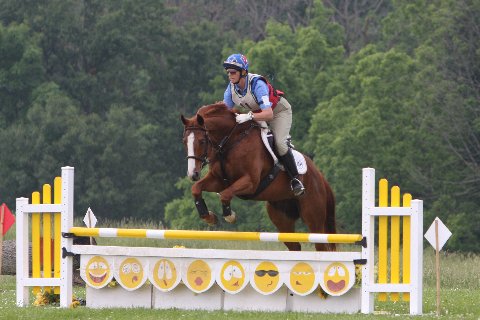
On to fence two, a shiny maximum height pheasant feeder.  He cantered hesitantly down to it, felt extra wobbly at the second to last instant and exercised his right to wobble decisively left.  I could have stuffed him over it, I think, but I didn’t want him to have an awkward jump and scare himself.  I exercised my right to tap him on the butt once with the crop, gave him a second to reset his mind, re-presented to the fence and hopped right over the pheasant feeder on try 2.  Next, through the small creek (an easy deal for a foxhunter) and on to the barn jump.  He cantered on down to that and sailed it.  He’d seen this fence’s identical twin on the course 2 weeks ago, so he was good with that.  Canter up the hill and up the bank.  This was more like it for him.  Terrain issues are a foxhunter’s forte’.  He took that bank like a professional and now he was getting in a bit of a rhythm.

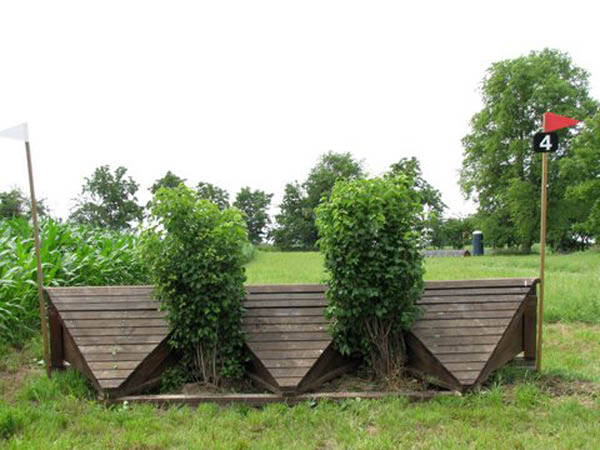
skinny chevron

Canter down the hill and up the next and on to the skinny chevron.  I had wondered how this one was going to go when I walked the course because some horses don’t think they will fit between trees like this.  I had one horse who actually jumped a 5′ showjumping standard in a clinic when the clinician set a skinny showjump.  The horse was sure he would not fit between them, but didn’t like to stop or runout, so, very logically, he jumped the standard.  His rider managed to stay in the tack by sheer benevolence of the Universe and the horse staying straight upon landing.  Had he done any minor squiggle in the first two strides after the fence, I’d have been a lawn dart.  Good man.  So I cantered down to the skinny chevron with a leg on, but wondering how this might go.  Sammy jumped it straight and true, no muss no fuss.  Yay Sammy, because the next fence was a bending line two stride log combination in the woods.    There was a lot of talk about the combination on course walks.  There was walking and rewalking the center distance, the inside distance, the outside distance.  As for me, I loved the combination, nice round logs, good footing, nice distance right down the middle, nice size.  And voi la!  Sammy agreed.  Smoked on over that combination.  Good man.

Trakehner. "Did you know there's a ditch under that?"

Next a let-up coop that rode easily and then down to the trakehner.  He’s done trakehners before, but still he was a little rattled early in the course and, though he was doing really well, trakehners are still funny things to horses.  He cantered down to it and at the last minute turned left exclaiming, “Camie, did you know there is a ditch under there?  I’ve got a solution for us.  Let’s go this way instead!  Look, no ditch!”  I think I actually giggled a little.  I know he can jump the height and I know he learns quickly, so I took a breath, gave him a pet, walked a few steps away, picked up a canter and asked him to have a try again.  He jumped it perfectly.

That was a turning point.  I think I heard an audible “click”.  He figured out that the easiest and most fun thing is to go over whatever is in front of him.  “Ohhhhhh.  I get the game.”  It was really cool.  In that instant, I knew the rest of the course was going to be pure fun.  He dropped into the water like a star.  Did the barrels in perfect stride, the combination felt like a gymnastic and we went down the down steps, both grinning like crazies. 

The steeplechase fence rode just like a real steeplechase fence, forward and confident.  The corner was easy and then on to the coffin complex.

Ok, this picture is from last year's prelim. Replace the coop with a table and put the c element to the left a bit and you have the training coffin 2010. There's a creek between the two jumps.

On the course walk, I was a little concerned about the coffin.  I jump judged it last year and I’d seen some inexperienced horses come up to the first element, start to jump, see the water on the other side, stop jumping and slither on their front legs back down the jump. Faced with that, a few riders stayed on and a few ejected.  No lasting harm to anyone.

So now I was cantering down to the same complex.  But I was not on the same horse I’d started the course with.  I was on One Who Got the Game.  Even cantering down to it, I knew it would go well.  He sailed over that table, took the creek in stride and actually locked on to the prelim C element.  I had to pull him off and send him to the training C, which he sailed easily.

Next a coop.  I giggled to myself coming down to it since a foxhunting friend of ours had remarked to herself about a coop on her course at a different horse trial.  “It’s just a coop.  We jump them all the time.  No problem.”  And promptly got eliminated at it on xc day.  So I rode the coop properly and with respect and it went well.

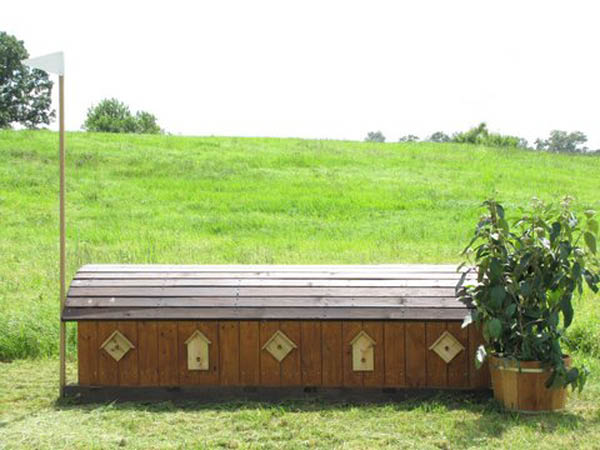
Birdhouse rolltop. Built by husband Jay and sponsored by Julie Kuhle as a memorial to her bird-watcher mother. Lovely.

The new bench was a lark and it was great fun to jump the birdhouse, which had spent a few weeks being born in our garage a few winters ago and was delivered to the park in our horse trailer.  And GREAT fun to jump.  Then a nice big table, and pet and praise the horse through the finish flags.

The 10th place ribbon is a very pretty cornflower blue.  And it was the Best.  52.8 penalty-ride.  Ever.

How to make your horselife more relaxing and safer

Being a horse is confusing sometimes.  You get on a trailer, spend a couple of hours with your balance constantly changing, back off the trailer when it stops and you’re somewhere new.  Maybe you are going to a new owner.  The trailer drives off and you are in a place where every variable in your life has changed.  New surroundings, new person to interact with, new horses to meet, new pecking order to establish, maybe new food and maybe water that smells funny to you.  Quite possibly, new rules from the new handler.  It can be a scary time for a horse.  Here are some tips I find useful in helping horses to relax and perform when they arrive at a new or temporary home.

Quality of Energy In = Quality of Energy Out

A relaxed horse, trusting his rider, and the rider allowing a slack rein, in trust to her horse. Sarah Hannapel photo

Horses, you may have noticed, don’t talk much generally.  There is the occasional outburst and some friendly nickering or “meet the new guy” posturing sounds, but generally, they’re quieter than humans.  They are into physical cues.  They read energy for the most part.  When you approach a horse with the attitude of Benevolent Dictator (BD), that person who will assume the position of making decisions for both parties, but who will put the horse’s needs to the forefront, you will be given right of way as leader by the horse and the experience of being the follower will relax the horse.

The two parts of Benevolent Dictator nest into each other.  For instance, sometimes when a horse is in a new situation, he will exhibit resistance to being led, either figuratively or literally.  Maybe he literally will not move, or maybe he is whinnying himself silly and skittering about.  At this point, the BD is wise to employ the Miz  Scarlet Effect a brief, but moderately strong suggestion, repeatable as needed, that the horse’s best interest is served by having his attention on the handler and following directions.  This correction is both a Benevolent and Dictatorship act because horses and handlers are safest when their attention is focused in the same direction.  Benevolence is also manifested when the horse is praised when he keeps his attention on you.  The Benevolent Dictator makes being with her more fun and relaxing than “being”, physically or mentally, somewhere else.

More on Benevolence: No Fingers, No Face Scratch

My horses' favorite scrubbie

Horses, you may have noticed, do not have fingers.  Hooves are handy for crossing rough terrain, but they’re inconvenient in many ways.  Imagine going through life not being able to scratch your face or ears, and often having flies on your face, to boot.  This might be why most horses lurve face rubs.  Rubbing a horse’s face in long, easy-to-predict strokes with a rubber scrubbie both with and against the hair while the handler puts her hand under the horse’s chin or jaw for support is perceived by many horses to be a very benevolent act.  Their respiration slows, they close their eyes and they think good thoughts about you.  (Ok, my fantasy, but a nice one to visit every day.)

No fingers also means no Q-tips.  Horses’ ears get waxy or itchy just like ours do, but again, the no finger thing. That’s where you step in and help and make an instant friend or at the very least find out more about your horse.  Put a kleenex on your finger and gently put it in his ear and see if you can gently rub some of the dirt/wax out.  Some horses love this, some horses wonder what in the heck you are doing and please maybe not so much of that.  If not, let it be.  Just offer and see what happens.  The ones that love it do this funny thing with both their upper and lower eyelids that I have only seen them do when their ears are cleaned, and all horses who like it make the same face.  Must be the universal ear delight face.  It is hysterical and you’ll know it when you see it.

Many horses also have a swirl of hair in the middle of the bottom of their bellies where the flies love to bite.  Scratch this.  Then put swat on it.  More good thoughts to you from horsie.

While you are distributing all this Benevolence (and feeling the love back), the Dictator is also there, making sure basic rules are followed.  If horsie looses focus and starts whinnying or skittering about, invoke your right to a swift Miz Scarlet Effect, growl for a maximum of two seconds and then let it go and proceed back to Benevolence mode.  If you made that quick energy change in an interaction with a person they’d call you Sybil.  When you do that to a horse, they are happy to have gotten clear direction.  And they usually step happily right back in line.

Moving backwards down the horse’s body, if you have a mare, run your hand along her belly until you reach her teats.  If she will allow it, check between her teats for icky crusty stuff.  It builds up there and I bet it itches like heck, because most mares are delighted to have you gently remove it once they figure out what you are doing.  Meanwhile, they are also figuring out that your intentions are good.  This goes a long way to improving their confidence in their environment and you.  A confident horse is a safer horse.

If you have a gelding, it gets a little more complicated as they can telescope their thingies into the netherworld and most people aren’t going to go spelunking after it.  Some geldings, though will welcome you removing some of the dead skin off of their winkies if you are gentle, and don’t tell me that doesn’t feel good to the fingerless-types.  This is all entirely trust building through hygiene.

When it is time to do the soft-brush-on-the body routine, get a seriously soft brush.  If you can run it down your cheek and be happy, you are there.  Start with the top of the horse’s head.  Move the forelock to the right and groom the area between it and the ears.  Then do the same on the left.  Then groom the outside or even upper inside of the ears if the horse will allow it.  Then, use long strokes that go from the middle of the face, following the hair, smoothly over the eyes, which the horse will close as the brush goes over, and then down the cheek.  Spend a full minute or two on the face alone.  Some horses like to have it run down the channel of their cheekbones, underneath their head.  As you do this, look at the horse’s reaction of relaxation, slow your breathing and just allow the connection.  Many horses will draw a long sigh of relaxation while you do this.  The Dictator program is always running in the background, correcting the horse if he starts to rub on you or fidget around or otherwise be distracted.  He is supposed to passively allow you to kindly groom his face.

When you groom the rest of the horse, if you are not removing mud or having to otherwise scrub, use long strokes and breathe long breaths.  Let your free hand rest on the horse, having placed it there palm first.  I haven’t quite figured out why, but if you watch really good horsepeople, they rest their whole palm on the horse and feel, rather than let their free arm hang or spider their fingers over the horse, with their palm held away.  Regardless of the reason, horses relax when touched with the whole palm in long strokes in the direction of the hair.

Feed Cookies

At will.  And the people who say not are silly meanies.

Pick Up Hooves

Yes, you should do it for all the reasons you know you should, but you should also do it because a horse who will calmly shift his weight to his other legs and allow you to futz with the remaining one is a horse who is confident in you.  Spend time getting this right.  Not just holding it in the air for the 8 seconds it takes you to pick it, but spend time helping them learn that yielding their body to you is not scary.  This isn’t just a “yes” or “no” will-he-pick-up-his-feet-for-cleaning thing.  This is a connection thing.  When a horse does this efficiently and confidently, the ride goes well.  If I have a horse who isn’t calm and relaxed in yielding his body to me in this manner for whatever reason and we don’t resolve it, it tells me I have more work to do on the ground, and I’m not getting in the tack today.  No biggie, glad to know it before I am in the tack.  Time spent getting this right and getting better connected is always well spent.

Extra Credit

Lots of horses like to have their heads held.  What? Seriously.  Lots of horses, when they are relaxed and in a calm environment, like to have their heads held by their people.  Several, ok all, of my horses will walk up to me and place their whole head right in front of me so that I can put one elbow over their nose and one elbow over their upper neck, which puts my face in the perfect position to kiss them right behind their ears.  They love this. They make big happy sighs and will stay there as long as I do.  They relax their necks and curl around me.  You don’t want to rush into this or even have it as a goal because some horses are more into it than others and horses’ heads are heavy and solid and can move very quickly and hurt you.  You wouldn’t rush in and kiss a person you don’t thoroughly know wants you to kiss them.  Same or even moreso with horses.

Connection = Relaxation = Greater Chance of Safetly

When we put ourselves in the position of Benevolent Dictators, taking both aspects of that title to heart, we open a channel to greater connection to our horses.  This relationship is one of caring and empathy with a lack of fear in both parties.  When we have greater connection we have more trust and relaxation from both handler and horse.  When we have trust and relaxation, horses are more likely to react predictably and calmly.  Even when things don’t go perfectly, a horse who has been handled with consistent Benevolence and Leadership is likely to look to its leader for relief rather than improvising his own.   

Corn and Conscious Competence

Eddie the horse in corn

Eddie the 17h tb says, "Knee high by the Fourth of July?"

I was out on a hack today with my eventer, Eddie.  We do a lot of hacking around for conditioning on the land our kind neighbors allow us to ride.  Most of it is CRP ground, but there are a few short stretches of  crop ground we sometimes pass through.  This spring it was easy to hack on down between the corn rows, avoiding the small plants, but in the last week, aided by a lot of rain and then a week of sun, the corn has shot up to the extent that 17h Eddie found himself having to stretch his neck up in order to see anything in the sea of cloying corn leaves.

Temple Grandin wrote a great book called Animals in Translation.  One of the many theories she puts forth in the book basically says that the lighter-built animals within a type of animal are generally more sensitive and quick-to-react to outside stimuli than their heavier-built counterparts.  I tend to think of the more reactive animals as “brighter” though I note that I don’t mean this to mean more intelligent.  I think of those animals that are slower to react as “duller”, and this does not imply less intelligent, just less reactive.  So, for instance in dogs, a greyhound might be considered brighter than a newfoundland and a draft horse might be considered duller than an arab, just on Temple’s theory alone.  Temple goes on to say that the lighter animals within a breed are usually brighter too.  So a spindly-legged tb could be predicted to be brighter than a more solid-type tb.  This holds true in my experience in general and in my barn at the moment.  Charlie, our foxhunter, is a bigger, heavy tb, still purebred, just heavier-boned, and he’s just as steady and sweet as the day is long, and he’s not given to over-reaction.  Eddie is a skinny, long-legged, long-necked wisp of a narrow tb and he is as bright as they come.  He is given to Anxiety Groans when he is uncomfortable or doesn’t understand things and I guarantee that if there ever really IS a mountain lion near us, he won’t be the one it gets.

So, now I’m on a hack with Eddie the Bright in a cornfield up to his ears, with the leaves pressing against his body from muzzle to croup, withers to hooves.  He gets light on his feet.  He lets out his Anxiety Groan. He breathes faster.  He champs at the bit and his pace quickens.  I simply put him in a shoulder fore (really, it’s no problem, the corn row limits the angle, like bumpers in a bowling alley) and let the distraction of its effort, combined with a consciously relaxed elbow, quiet hugging leg and steady breathing, settle him.  He gets to the other side with little problem.

Eddie’s little moment of anxiety, though, reminded me of the progression of learning how to ride.  When I was a kid, I had the Greatest Shetland Pony in the World, apparently, judging from all the horror stories I hear of other peoples’ experiences with shetlands.  Cricket and I spent many afternoons playing cowboys and indians with my sister and  her horse, who was born at our house and who we imaginatively named Grasshopper, since, if you have a Cricket, you obviously need also a Grasshopper.  We were 8 and 14, and thought we were clever.  Oy.  Anyway, a favorite tactic of Cricket and I was to enter a cornrow at the end and pretty much gallop down it to get away from my marauding sister on her much faster horse who was too wide to follow.  Cricket was entirely unfazed by the lack of visibility, swinging corn ears and pressing leaves as we bucketed down the row, partly because he knew I would pick something delicious for him to eat once we escaped the marauder.

Then I had my friend Ruth out and we went for a ride, me on Cricket and her on Mariah, a big, kind morgan we had.  Mariah was a beautiful, well-mannered bay, and quite tolerant.  So I was surprised when I led Ruth, trotting down the corn row, only to be rapidly passed by a white-eyed Mariah and clutching, shrieking Ruth.  I had no idea that the claustrophobia of the leaves and the lack of ability to see over them could cause a horse to do that.  At that moment I became aware of my incompetence.  The first step in learning is Unconscious Incompetence where I had merrily lived before that moment.  I had been enjoying, unaware, the benevolence of the Sprites Who Protect the Ignorant.   Now I was in the land of Conscious Incompetence, with all the heaviness-of-being it brought.  Conscious Incompetence, to me, was extremely uncomfortable and I had to move on ASAP.

Ruth was a farmkid with good balance and a heckova good sporting sense of humour.  Mariah’s eyes popped back into her head as soon as she got out of the corn, and we had a nice day of it, other than the niggling thought in the back of my head concerning the fact that I had no idea in my 8 year old brain how to teach Mariah to not be scared of the corn.  And I really wanted her to not be scared of the corn.  So I read books and asked anyone who might know how I might desensitize the mare to the corn.  I learned some tricks and slowly desensitized her and she was ok to walk in the corn, but not trot or canter like Cricket.  I had to get more tools.  But where?  The people I knew were fresh out of ideas and probably wondered why I was so obsessed with cantering a horse down a corn row anyway.  My little brain said that if Cricket could, somebody had to have taught him.  I’d never seen a horse just canter down a corn row by himself, so somebody had to have taught him, I reasoned.  (Ok not entirely logically sound, I know, since most horses don’t have the opportunity or reason to canter down a corn row, but I never got that far in my little kid reasoning.)

About the same time, I started taking dressage lessons, after a fashion.  Since I was more wild child pony jockey than classical equestrian, my instructor spent a fair amount of time frowning and teaching me circles and how to carry my hands.  One day though, I must have finally gotten somewhere close to getting it, or simply bored her silly.  She started talking about bending the horse on a straight line.  Shoulder in, haunches in, shoulder fore, haunches out.  We just brushed the surface in that night’s lesson, but I was on fire.  Now again I hit the books and quizzed whoever I could to learn more.  By my next lesson I was doing a fair shoulder in, that actually made my instructor smile.  The little wild child monkey might not be a complete waste of space in the lesson.  It took every ounce of my brain energy to get my body and the horse’s body to do what I had read about and was picturing and practicing at home, but by jiminy, her smile said I was doing it or something in the same zip code as it.  Welcome to the world of Conscious Competence.  In this place we master, on fledgling wings, what we later will do without thinking, with ease, as muscle memory does its magic.  This place of Conscious Competence is a land of private work that happens only between the rider’s ears.  No instructor can do this for her rider.  The work of Conscious Competence is the basis for the axiom, “Princes learn no art truly, but the art of horsemanship. The reason is, the brave beast is no flatterer.”

I soon learned the power and usefulness of being able to influence the individual parts a horse’s body.  When a horse’s body is yielding to the rider’s leg, and when his poll is relaxed, it is easier for him to stay mentally with the rider and to relax.  If the horse and rider are trained properly, they can communicate in times of crisis, such as when a horse can’t see over the corn leaves and they are being touched all over by the leaves.  I could put Mariah in shoulder in in the little grass paddock we had, could I do it in a corn row when she got worried?  The short answer was no, not for quite a while.  I needed to have the connection without effort, to have it in my muscle memory.  Unconscious Competence comes to those who are motivated to put in the work, and time is undeniably an element of work.  It took a lot of practice in the arena before our communication was good enough to be helpful to the horse in an anxious situation.  But it did come for us, and it was really fun to canter a big horse down the corn row!

Whatever you want to do, be fearless.  Be hungry, try, make mistakes, endure setbacks.  Celebrate every victory.  Learn from every setback.  Put your eye on the prize and do not take it off.  The beauty of Conscious Competence is that it dances with the one that paid the cab fare.   Do you have the change?

Jumping the oxer backwards

Sammy and Camie jumping a vertical the correct way... Barbara Hall Photo

The course at the schooling show called for jumping a single vertical, roll back left to another vertical, bending line to an oxer, then left to a vertical with a big puddle that strongly suggested it be jumped well left of center.  After that another  rollback left.  It was about 90 degrees with high humidity and I’d done a pretty good job of keeping myself and my horses hydrated and well rested.  I was pretty proud of myself for finally implementing the plan to keep us all doing well.  My dad, a dairyman in his youth, always said, “Take care of the stock before you take care of yourself.”  That’s a really good plan until the person taking care of the stock passes out from heat exhaustion and then there’s no one left to take care of the stock.  My Dad was great and I still love him silly, but I’ve lately subscribed to the flight attendant mantra:  put on your own gas mask first before assisting others.  So gatorade, water and snacks are always with me at horse shows and I take them in freely at the same time my horses are refreshing themselves.

So I can’t blame what happened at the schooling show on dehydration or heat exhaustion, but it makes for plausible shorthand if needed.  The real story is a little more involved and more fun.  We were doing the training level combined test. Dressage had gone well, with my up-and-comer, Sammy, coming within a point of my prelim horse, Eddie, who was doing the show mostly on a tune-up lark.  I was delighted with both of their tests.  On to showjumping.

Since it was a small schooling show, it was my choice which of the horses to ride first.  I decided to ride Sammy, since I would have a little more time to warm up the first horse I rode.  I was the only entrant at that height, 3’3″, and it turned out I was the last to go in the only ring that still had classes running in it.  The show staff were politely, but periodically, looking at their watches.  I had both horses tacked up and ready to go when they had the course set, and a friend was holding Eddie while I rode Sammy.  I entered the ring after a brief warmup and Sammy felt great.  He picked up a lovely balanced canter, the buzzer sounded and off we went over fence one.  Roll back to fence 2, bending line to the oxer, no sweat.  Turn left to the puddle fence, where the trouble began.  I hadn’t walked the course because 1) the footing at the show was generally great, despite the 2″ of rain that fell overnight; 2) I was confident in my horses at the height, and  3) I didn’t have opportunity to walk the course due to having ridden another dressage test on Eddie for practice at 2nd level just minutes before.   Those are my excuses and I’m sticking with them.

So now I was faced with jump 4 and the big puddle.  The obvious solution was to jump it left of center, from the beach, rather than the tidewater.  I asked Sammy for a few steps left in canter, a cross between half pass and please-get-left-quick-horsie.  He was fabulous about it, kept the rhythm, jumped neatly out of stride and we landed, yay, and having accomplished that, I immediately blanked regarding what the next fence might be.  The puddle had surprised me and I’d used all my available brain space to get the horse to a good spot to deal with it and I could not for the life of me think where to go next.

At one  point early in my riding career, faced with the same difficulty of having no living clue what the next fence was, I’d actually stopped the mare I was on to take a quick look around, figured it out, picked up a canter and finished the course.  I thought I was so clever to buy myself some time!  I quickly learned that stopping, even unrelated to a fence, was counted as a refusal in showjumping.  D’oh!  The agony!  An honest-to-the-TD, skidding, rail-splintering crash of a refusal is one thing, but being assessed the penalty for a refusal without a really good story is just not palatable.  So, rather than go wimpering down in a mewling penalty at this show, I figured I’d canter on and look about for a likely candidate that might suffice for jump 5.

Well, lookee here, straight ahead, nice square oxer and I’ve got a nice canter going.  What a bonus.  One stride later it dawns on me that there is no ground line on this side of it, and it isn’t square, it is slightly ascending, from the other side.  At moments like this I tend to simply keep doing what I’m doing and think at light speed.  So in the next stride, the thoughts that went through my head were: 1) I should pull him off, that is obviously not the right fence; and 2) but this is a really fab canter and the distance is perfect, it will sail; and 3) he’s a relatively green horse and this is a schooling show, so I don’t want to pull him off and give him a jar; and 4) he’s a relatively green horse so I should not ask him to jump a ground line-less descending oxer; and finally came to the conclusion 5) hell with it, Lucinda Green jumps ascending oxers backwards as a matter of course in her training and Sammy’s been jumping bigger than this without a groundline at home and what does he care if it is a descending oxer, he’ll land 8 feet on the other side anyway.

Sure enough, he cantered down to it and sailed it very nicely.  And I rode the next few strides waiting for the whistle signaling my off course-ness and at the exact instant it went off, I came to the brilliant realization that I should have turned left after fence four and rolled back left to fence five.  D’oh.  I asked for and received permission to continue, and finished the course just fine.  Sammy never knew he was a victim of pilot error.  There was no hint of it in the party I threw for him when he crossed through the finish flags.

So I’m thankful that the people who educated me about riding and showing pounded into my thick head the habit of always schooling at a more difficult level than I show.  We all make mistakes or get surprised by things that happen in competition, and it is nice to have a little more horse or a little more training in my horse than I need to respond intelligently to the questions that come up in a competition.  I don’t go off course often and I don’t intend to do it again for a while, but it sure was fun cantering down to that oxer knowing it would go well, knowing I’d be eliminated for doing it and knowing I didn’t have to pull my horse abruptly off the fence and confuse him, because it was going to go fine.  His experience at home had allowed me the option of pitching the class rather than his confidence.

So, yeah, I jumped the oxer backwards.  And it was fun.